Fintech in Q3 — And Loads of New Functionality for the F-Prime Fintech Index!

Profitable Fintechs That Demonstrate Sustained High Growth Are Rewarded With Big Multiples in Q3. The Rest — Not So Much.

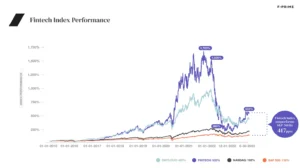
Headline: This quarter, we wanted to show how the Index has performed over the past year. After the significant decline in fintech stocks alongside the broader tech sector in 2021 and 2022, fintech disruptors have quietly recovered a lot of ground over the last twelve months. The F-Prime Fintech Index is up 80%+ LTM, though still ~60% off its 2021 highs. The F-Prime Fintech Index continues to outperform other indexes we’re tracking: the Emerging Cloud Index was up ~6%, Nasdaq grew ~27%, and the S&P 500 climbed ~19% over the past year.

Despite a year-to-date rebound, the F-Prime Fintech Index lost $74B in market cap in Q3, with the median market cap decreasing from $2.8B to $2.4B. Payments companies Adyen, Shopify, and Block drove 75% of the decline, losing $31B, $13B, and $13B respectively in market capitalization in the wake of earnings and profitability misses, plus headwinds in the overall market.

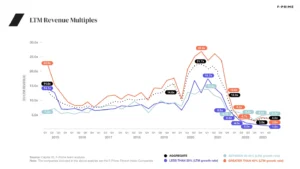
Multiples: Companies that continue to grow rapidly (that is, 40%+ YoY) have seen an increase in multiples to 5x, up from 3.8x last quarter. Investors are rewarding sustained high-growth with higher multiples — a reversion to historical valuations and a change from our last update. For the first time since Q4 2021, high-growth companies are garnering higher multiples than medium growth companies (see the flip in the chart above), despite the fact that most have not achieved profitability.

However, most high-growth companies are still trading significantly below their 2021 multiples, on average reaching ~40% of their Q4 2021 multiples. A few companies have nonetheless exceeded their 2021 multiples, rewarded for their sustained high growth and profitability. Well done, Wise — 72% YoY growth and 12% profit margins.

By sub-sector: Sectors that experienced significant valuation re-ratings in 2022 saw the biggest bounce back in Q3. Multiples in the lending vertical rebounded from 1.1x in Q4 2022 to 6.1x this quarter. Category leader Affirm increased to 6.8x from 3.7x; however, removing Funding Circle from the Index and Lufax’s lack of multiples (due to its negative enterprise value) account for ~50% of the increase in average lending multiples.

Macro and real-estate sector concerns continue to weigh on the proptech vertical which is still trading at ~1x, though better than 0.5x at the beginning of the year. Meanwhile, all proptech companies in the F-Prime Fintech Index saw multiples increase, with Blend seeing a jump to 2x from 0.8x.

While the durability of payments businesses has garnered stable multiples (4.5x for the past year), a few — Shopify, Flywire, Mercado Libre, Remitly, and Wise — have seen improvements in multiples. Likewise, B2B SaaS companies have continued to attain the highest multiples (more details below).

Index removals: While M&A activity continues to increase in both public and private markets, no F-Prime Fintech Index companies were acquired this quarter. However, Bright Health Group (BHG) no longer met our criteria and was removed from the Index.

F-Prime’s Summer Internship Program: Meet our 2023 interns and fellows

Thank you to our interns and fellow for their contributions this summer and for choosing F-Prime!

This summer, F-Prime was thrilled to welcome a talented cohort of interns and fellows to our Cambridge and London offices to help with competitive landscape analysis, sourcing, founder calls, and more. Read on to learn what it’s like to join our internship program.

“I have been able to explore new thematic areas in which the team was still building its knowledge base. By getting deep into the science and innovation through meeting entrepreneurs and academics, I have added to the team’s thinking and identified potential plays which culminated in presentations to the partners. A special shout out to Ana and Martin for the mentorship and support over the summer!”


“My time was split between assisting with an ongoing deal — leading a summer exploration project — and taking part in meetings with potential investments. I’ve had a great time in all of these activities, but I particularly enjoyed being an integral part of a deal team. Between self-guided research into standards of care, calls with key opinion leaders, diving into the relevant primary literature, and doing some basic market forecasting, I was able to leverage the clinical and research training I’ve received and develop so many new skills along the way.”


“I have been researching the biotech landscape of foreign markets and performing due diligence on interesting licensing opportunities abroad. I have also participated in many introductory and follow-up meetings with prospective US-based companies, where my research expertise and previous work experience have been invaluable in helping me evaluate each opportunity. I’ve learned a lot throughout the summer and was able to connect with people at all professional levels and across disciplines. One important skill I’ve been able to develop during my time at F-Prime is learning how to become versed in a new area of science within days, which is quite different from my Ph.D. experience of developing deep expertise in one area over many years.”


“I joined the F-Prime/FBRI team primarily due to the invaluable opportunity to collaborate with individuals deeply committed to fostering and accelerating my personal learning and professional growth. Although it is a lean team, I am fortunate because it translates to more one-on-one attention. I am getting opportunities to actively participate in diverse projects that make me feel valued as an individual, and that my contributions are noticed and appreciated (even as an intern!).”


“I was drawn to F-Prime because of the learning culture at the firm. I wanted to play a role in the translation of good ideas into real medicines and the firm has amazing people doing exactly that. On virtually every topic I encounter, there is a resident expert at the firm who can help me in framing my thinking. This ability to get to the right answer faster makes everyone more productive.

I also want to highlight that the deals the firm sees are a function of its reputation. People want to invest with F-Prime because they know they’ll not only receive capital but also an engaged partner who can help them along the trajectory of the company. This means that we see some of the most interesting ideas that will shape the future of medicine and often get to take part in their realization.”


“One of the exhilarating projects I’ve been involved in is the thematic research on Gen AI x Fintech. The possibilities with breakthrough technology like Gen AI are awe-inspiring. I find it fascinating to delve into its potential for the future and hear how visionary entrepreneurs contemplate disrupting the financial services landscape. It’s been an incredible journey so far, and I’m eagerly looking forward to sharing the outcomes of our research.”


“I have always planned to spin out my PhD research but had no idea how VCs actually decide to fund these projects. I joined to learn how other spinouts and startups pitch to VCs and learn about the decision processes that VCs make.”

Applications for 2024 are not open yet, but if you are interested in learning more, please send an email to careers@fprimecapital.com.

Technologies Enabling the Future of Robotics

In June, F-Prime co-hosted Robotics Invest, an invite-only summit packed with keynotes, panels, and case studies featuring the robotics industry’s most experienced investors, founders, and operators. During her time there, Betsy Mulé took advantage of this unusual concentration of tech industry talent by interviewing several founders — Yaro Tenzer of RightHand RoboticsHelen Greiner of Tertill and iRobotRajat Bhageria of Chef RoboticsDavid Morczinek of AirWorks and David Johnson of Dexai Robotics — about the state of the industry.

Here, they discuss the technologies that are enabling the current wave of robotics innovation, and what the future of the industry might look like.


Recorded at Robotics Invest

5 Lessons Robotics Founders Can Learn From the AV Industry

Founders must learn the hard-fought lessons of the last five years to find success in this unique category.

Throughout the late 2010s and early 2020s, the autonomous vehicle industry captured the imagination of the startup community and the public. However, the category’s meteoric rise preceded an even more meteoric fall over the last 18 to 24 months. From 2018 to 2021, investments in the AV sector across the U.S. and Europe increased by nearly 2.5x, eventually peaking at close to $10 billion in 2021. Then, in 2022, investments fell to $4 billion, with 2023 likely to see further precipitous declines.

Meanwhile, the broader robotics ecosystem has continued to flourish, with companies focused on mostly industrial “vertical” use cases now commanding the bulk of investment dollars. In 2022, these companies attracted $7 billion in investments, defying the broader slowdown in VC investment by growing 15% over the previous year.

We recently analyzed the trends shaping the industry in our State of Robotics report, and identified five lessons that the next generation of robotics founders can take from the successes and failures of the AV industry.
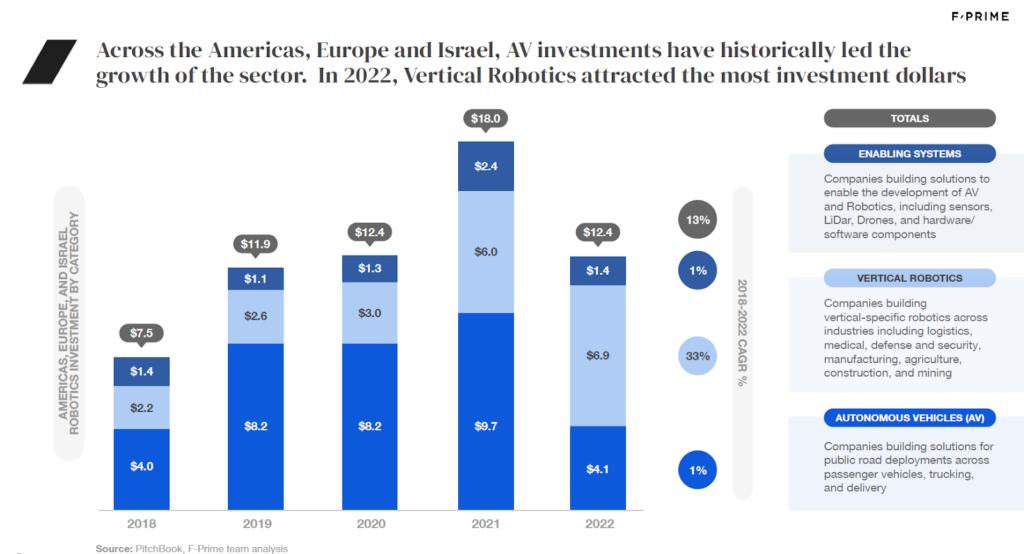
vertical robotics investment overtakes autonomous vehicles


VC excitement for hardware businesses is higher than ever

In the U.S. and Europe, more than $60 billion have been invested in robotics and AV alone over five years, with the AV sector leading the way. AI is making hardware much smarter, which is enabling companies to generate the kind of high-margin recurring revenues typically associated with software businesses.

AI also creates opportunities to disrupt traditional industries with massive addressable markets. For example, across the logistics ecosystem, AV companies such as Aurora are disrupting the trucking industry, while companies like Locus and RightHand Robotics (an F-Prime portfolio company) are transforming how fulfillment operations are done.

For founders, this surge in interest means there are more robotics investors than ever, ranging from newcomers in the category to those with an extensive track record in the space. Even top-tier investors such as Sequoia and Andreessen Horowitz are starting to make investments in the category, an encouraging bellwether for overall VC interest in robotics.

Nevertheless, hardware-oriented investments are not the right fit for all investors, and it’s best to seek out those who have made a commitment to robotics and understand what it takes to be successful.


You must eventually build a real business

Much of the early effort in AV focused on technology development, and success was defined by performance of demos and pilots. However, pilots are not the same as commercial success. As both acquirers and investors realized the challenges of creating self-sustaining AV businesses, capital started to dry up and many companies shut down or were forced to scale back their strategy.

Today’s robotics founders must focus on real commercial proof points at every phase of their journey. Investors want to see production deployments that deliver measurable ROI (return on investment). Pilot customers who are “excited by the technology” are very different from customers who are motivated enough to manage the operational changes required to adopt it and demonstrate high utilization.

At the same time, founders must demonstrate attractive unit economics associated with their offering — for example, more than 70% gross margin after subtracting BOM (bill of materials) and support costs from lifetime revenues.


Use case selection matters

Early efforts in AV targeted the largest, most challenging problem: generalized autonomy on passenger roads. While the TAM (total addressable market) was massive and the use case seemed like the obvious one to target, technology challenges and uncertain timelines ultimately led many players to pivot toward more tractable use cases, such as trucking and delivery. Lots of capital was burned in that transition, and as investor interest waned, many companies did not survive.

Founders must identify use cases that have real value and that can be realistically automated without massive capital investment. Many companies are now pursuing use cases in constrained operating environments with greater fault tolerance, and often with a human-in-the-loop element, which creates more technical feasibility. Identifying such use cases where the TAM is still significant is the sweet spot for a VC-backed robotics business, often requiring founders to have a deep understanding of the target industry.


Acquisition and exit activity drives a virtuous cycle of investments

GM’s acquisition of Cruise for $500 million in 2016 sparked the AV race. The deal made the startup community realize AV’s disruptive potential in the eyes of incumbents, and how much capital they were ready to invest in the acquisition of technology. The ensuing years saw annual AV investments take off, the creation of 10 AV unicorns, and large IPOs or acquisitions for companies such as Aurora, Zoox, and Uber ATG.

The lesson for startups is that large incumbents can propel investment momentum and help overcome investor reluctance around what may be a still-unproven use case. Investors will look to incumbents for validation of the problem statement, and many incumbents are starting to actively engage startups for exactly this purpose, like John Deere’s Startup Collaborator and Suffolk Technologies’ BOOST. If your startup is able to drive real customer value and disrupt legacy business models, incumbents will eventually come calling, even if they are not yet active acquirers. Investment dollars will follow, more incumbents will jump in, and startup formation will accelerate.


Only the strong survive

AV businesses were very capital intensive, and as investments ebbed, only the strongest players were able to continue raising capital. Even companies such as Argo AI, with more than $1 billion of capital, were ultimately shut down, whereas Aurora was able to raise an additional $820 million as recently as mid-2023.

Founders must focus on being the winner in your chosen segment or use case. There will inevitably be competition for any good idea, and those startups will often find willing early-stage investors to support them. However, being an “also-ran” is ultimately a losing strategy in robotics. Later stage dollars will flow disproportionately to the winner, customers will favor the most established providers, and acquirers will focus their efforts on the market leaders.

Today’s robotics founders have a number of factors on their side: technological acceleration, labor shortages, stagnant productivity gains, and a cadre of investors who are increasingly interested in the category. However, founders must learn the hard-fought lessons of the last five years to find success in this unique category.

Originally published in TechCrunch. Read the full story here.

Check out our State of Robotics report here.
Influencers Are a New Class of Travel Agents — But Lack the Right Tools

For many, “travel agent” sounds like an anachronistic job title, conjuring images of shoulder pads and strip malls, corded telephones and desktop computers with cathode-ray tube monitors. Indeed, ever since the advent of online booking, travel industry watchers have been predicting the demise of traditional travel agents. But in reality, travel agencies are still estimated to be a $72 billion industry in the United States alone, and upwards of $450 billion globally. Travel agents haven’t disappeared, many have just swapped the drab offices and chunky monitors for ring lights and smartphones.

In this story for travel industry publication PhocusWire, Betsy Mulé explores the opportunities awaiting startups who can build useful tools to help influencers step into their newfound role as modern travel agents.

Read the full story here.

Originally published in PhocusWire

How Quovo Became Embedded in the New Financial Services Tech Stack

Lowell Putnam joins David Jegen to reflect on Quovo’s biggest wins

If you’re a fintech startup and the prospect is a top three bank, the answer is probably “as much as possible — without breaking your team.”  

In the late 2010s, financial API startup Quovo spent two full years selling and onboarding one of the largest banks in the United States. 

“We were a company of 60 people at the time, and eight of them had to be on a call with this bank every day, five days a week,” CEO and Co-founder Lowell Putnam said recently, speaking with F-Prime’s David Jegen about their partnership in the years after we co-led their 2017 Series B. “They did all of their releases on Saturday nights after midnight, and they needed people from our team to listen in. Not a lot of startups are ready for that.” 


“It was quite telling that one extremely old and traditional FI would reach out to acquire Quovo at the same time that you’re also getting offers from one of the fastest-growing companies in fintech.”

David Jegen, F-Prime Managing Partner


The Perks of Being a Grownup 

Nevertheless, David and other investors on the board backed the team to close the deal. Quovo ultimately won one of the largest open banking contracts in the U.S., a market-moving vindication of the company’s account connection and aggregation services — and its implementation team’s execution.  

“Having a top three bank, especially, gave us this great sense of being a grownup compared to the other folks out there,” Lowell said. “We remain one of the few startups that had a contract from them, but it was a two-year process. David and some of our other investors stuck with it the whole way: ‘Keep doing it, keep putting the implementation resources in.’  

“And everything that went into that deal ended up making the company stronger. But if you guys hadn’t supported us — because it was bending everything from a spend standpoint — it would’ve been so much more difficult.” 


The Mafia Effect 

Quovo developed some serious go-to-market muscles selling to a major bank, and they helped the company knock down logo after logo across the financial services industry in the years after that deal.  

“We had to build a full implementation, customer success, and account management team — and not like, you know, a typical client success team taking folks out for beers,” Lowell said. “Some of the folks from that team are now doing amazing things. Adams Conrad, a principal who’s crushing it at QED right now, was managing our entire relationship with Betterment. Nicole Newlin is doing great things at Ocrolus. Our first data science hire is now a senior member of the engineering team at Plaid. And the rest of Quovo saw this team putting out fires for that one big bank — it just grew the rest of the company up, too. It was incredible for the culture.” 

 “I often say that successful alumni say as much about a startup’s founders than the ultimate financial outcome,” David added. “And I think it’s a wonderful statement that the people Lowell attracted and helped to grow went on to do other great things.” 


Building Again  

With great logo diversity among its customers — from financial titans to tiny startups — and clear momentum, it wasn’t long before acquirers came knocking. 

“You had a foot in the world of big financial institutions,” David said, “and fielded an offer from a player in that space who respected you and Quovo in a way that was disproportionate to your size. 

“It was quite telling that one extremely old and traditional FI would reach out to acquire Quovo at the same time that you’re also getting offers from one of the fastest-growing companies in fintech. It ended extremely well.” 

Plaid and Quovo ultimately combined to become the clear category leader for financial data aggregation and account authentication, and one of the great success stories of the fintech disruption.

The RTP Gold Rush: 10 FedNow Predictions

Originally published in Forbes

The United States’ long-awaited real-time payments (RTP) system, FedNow, is due to launch any day now. The availability of instant money transfers has huge potential to impact virtually all players in the economy, from financial institutions and corporate giants to online shoppers, small business owners and employees.

In her second story as a Forbes contributor, Rocio Wu draws parallels between US payments infrastructure and the rest of the world, where centralized RTP infrastructure has been up and running for some time now. The result is ten predictions about how the payments landscape will change now that FedNow is live.

Read the full story here.

E-Commerce Divergence & the Neobank Conundrum

The Fintech Index in Q2: Cautious Optimism Despite e-Commerce Divergence

Let’s dive in.

Headline: The Fintech Index was up 21% in Q2 (+69.2% YTD), from 423% at the end of Q1 to 533% at the end of Q2. Overall, the Fintech Index outperformed other indexes we’re tracking: the Emerging Cloud Index was up ~10%, Nasdaq grew ~13%, and the S&P 500 climbed ~8%.

The Fintech Index regained almost $40B in market cap in Q2 with the median market cap increasing from $2.5B to $2.8B. As we would expect from larger companies, especially amid a turbulent macro environment, the average LTM growth rate for Fintech Index companies continued to decelerate, falling from 48% (Q4) to 35% (Q1) to 28% (Q2).

A Tale of Two E-Commerce Platforms: There was one company that drove the index’s gains this quarter: Shopify. The company makes up ~16% of the Index and was up 35% in Q2. Shopify’s rebound primarily took place during the first week of May, when the company announced surprisingly robust first-quarter results along with its decision to abandon its logistics aspirations via a Flexport partnership. The e-commerce giant increased GMV by 15%, raised its subscription plans by an average 33%, and cut its workforce by 20%.

Conversely, MercadoLibre, Latin America’s largest e-commerce platform was the biggest drag on the Index this quarter, after a strong Q1. The stock makes up ~12% of the Index and was down 10% in Q2. While the company is still growing at an attractive clip (~30% YoY), its fintech business is decelerating. The fintech segment historically grew by 100%+ QoQ but grew by 64% in Q1 2023 (after posting 93% growth in Q4 2022). This deceleration weighed on public investors’ minds in Q2.


Source: Fintech Index


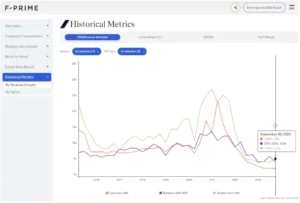
Multiples: The public markets continue to value goldilocks performance: solid growth with capital efficiency. Companies growing 20-40% traded at a higher 5.7x EV/Revenue multiple than companies growing faster than 40%, which were valued at 3.9x EV/Revenue. Overall, the broader Fintech Index continues to trade below historical averages, though there are notable outliers like Shopify (13.4x), Xero (13.3x), Bill.com (12.3x), and Flywire (9.6x).

By industry: Fintech B2B SaaS, lending, and wealth & asset management companies saw modest increases in multiples over the past quarter.

  • Fast-growing fintech B2B SaaS companies such as Bill.com and Xero have a 12.8x multiple. However, that’s still a significant decline from the 50x multiple that companies in this category enjoyed at the market’s peak in Q3 2021.
  • Fast-growing lenders like Affirm have nearly doubled their revenue multiples over the past 6 months to ~6x.
  • Similar to high-growth lenders, growing wealth & asset management companies like Coinbase have seen their revenue multiples almost double over the past six months as well, currently trading ~5x.
  • Check out the Fintech Index website to explore multiples for each sector and growth rate.

Index removals: While M&A and acqui-hires are ramping up, none of the Fintech Index companies were acquired this quarter. However, Dave no longer met our criteria and was removed from the Index. More on that below.

Index Additions: None

Fundraising: North American fintech startups raised a total of $2.7B in Q2, pretty much on par with Q1 if you exclude that massive Stripe deal.


Consumers Still Like Neobanks. Public Investors, Not So Much

Despite continued revenue growth, a march towards profitability, and stable unit economics, neobank valuations continued to decline. We removed Dave from the Fintech Index because it failed to meet our market cap and liquidity criteria.

Dave has maintained strong growth for both revenue (37% YoY growth) and membership (27% YoY). The company’s credit metrics have also demonstrated consistent stability, with notable improvements in unit economics. Customer acquisition cost decreased 39% (YoY), from $26 to $16 while ARPU grew from $121 to $124. Credit metrics also showed overall stability, with Q2 net charge-offs ~10bps lower YoY at 2.4%, and the 28-day delinquency rate 67bps lower YoY at 2.6%

More broadly, neobanks continue to gain market share against incumbent banks, accounting for 47% of new checking accounts opened (2023 YTD) up from 36% in 2020. The share held by megabanks (>$1T in assets) fell from 24% to 17% over the same time period.

Nonetheless, public investors have reservations about the neobank model. By the end of the quarter, Dave’s enterprise value ($47M) had dropped 98% since its public listing in January 2022. In order to avoid delisting from stock exchanges, Dave and other neobanks conducted reverse-stock splits to exceed the NYSE minimum of $1. However, despite these efforts, share prices continued to decline. Public investors remained concerned with:

  • Credit Cycle: Dave successfully built a model to serve lower-to-middle income consumers who were previously underserved by major banks; however, in a negative credit cycle investors are especially apprehensive about the potential impact on Dave’s customer base. A downturn in the economy or a rise in credit defaults could significantly affect the company’s profitability
  • Customer Base: Dave’s younger customer base has lower spending capacity and also raises concerns about the bank’s ability to grow ARPU
  • Low absolute unit economics: While Dave’s unit economics work, with such low absolute dollars per customer, Dave requires high growth and new customer acquisition to achieve profit scale. In a cycle where capital is expensive, Dave’s growth model is constrained.

It’s unclear if neobanks can outlast the current macro cycle or become cash flow positive to control their destiny, but we believe that in the fullness of time — and potentially in the hands of a larger balance sheet — the neobanks will play an important role in banking. We will track this segment closely over the coming quarters.


Written with Zoey Tang.

Stephanie Robotham

Stephanie is a Venture Partner at F-Prime, advising portfolio companies in the USA, Europe, and India on their GTM strategies for sales, marketing, and customer success. She is also currently a Value Accelerator Operating Advisor at Goldman Sachs Asset Management, and previously held roles at Salesforce, Cordial Inc., Iterable, and Optimizely. Prior to her current roles, she was CMO at Gainsight where she successfully re-structured the Marketing and Business Development organizations ahead of the company’s $1.1bn exit in 2020, gaining valuable M&A experience along the way.

Stephanie brings more than 30 years of experience building and advising impactful and customer-centric sales and marketing teams at high-growth SaaS companies. She understands growth stage, scale-up, and established public company structure and culture, with knowledge of scaling companies from $3M ARR to more than $300M.

Stephanie is a graduate of the University of Northumberland, where she received a degree in Marketing (Hons).

Henry Trapnell

Henry Trapnell joined F-Prime as a Director of Industry Networks to support the firm’s Tech Fund in the U.S. and Eight Roads Ventures abroad. He is a strong believer in the power of community to fuel business growth, and loves connecting portfolio company founders with corporate leaders to build symbiotic partnerships.

Prior to F-Prime, he helped lead digital go-to-market strategy at Google for the company’s hardware & services. He previously advised corporate executives on behalf of J.P. Morgan, where he developed a nuanced understanding of the intersection between emerging technologies, finance, and personal relationships.

Henry graduated from the Stanford Graduate School of Business and studied Economics and Chinese at Boston University. He also serves on the board of the Chestnut Hill Community Association in Philadelphia.