Unbox Robotics builds automation systems tailored to real-world warehouse challenges. Designed and manufactured in India, our compact, modular platform combines proprietary hardware and software for fast deployment and effortless scale.
Sector: Technology
How much labor spend will AI capture? A lot, but not as much as the headlines suggest.
A core tenet has emerged that the AI opportunity is much larger than SaaS because it is going after labor spend which is 10-30x larger. At the headline level, this is undeniably true in almost every industry.
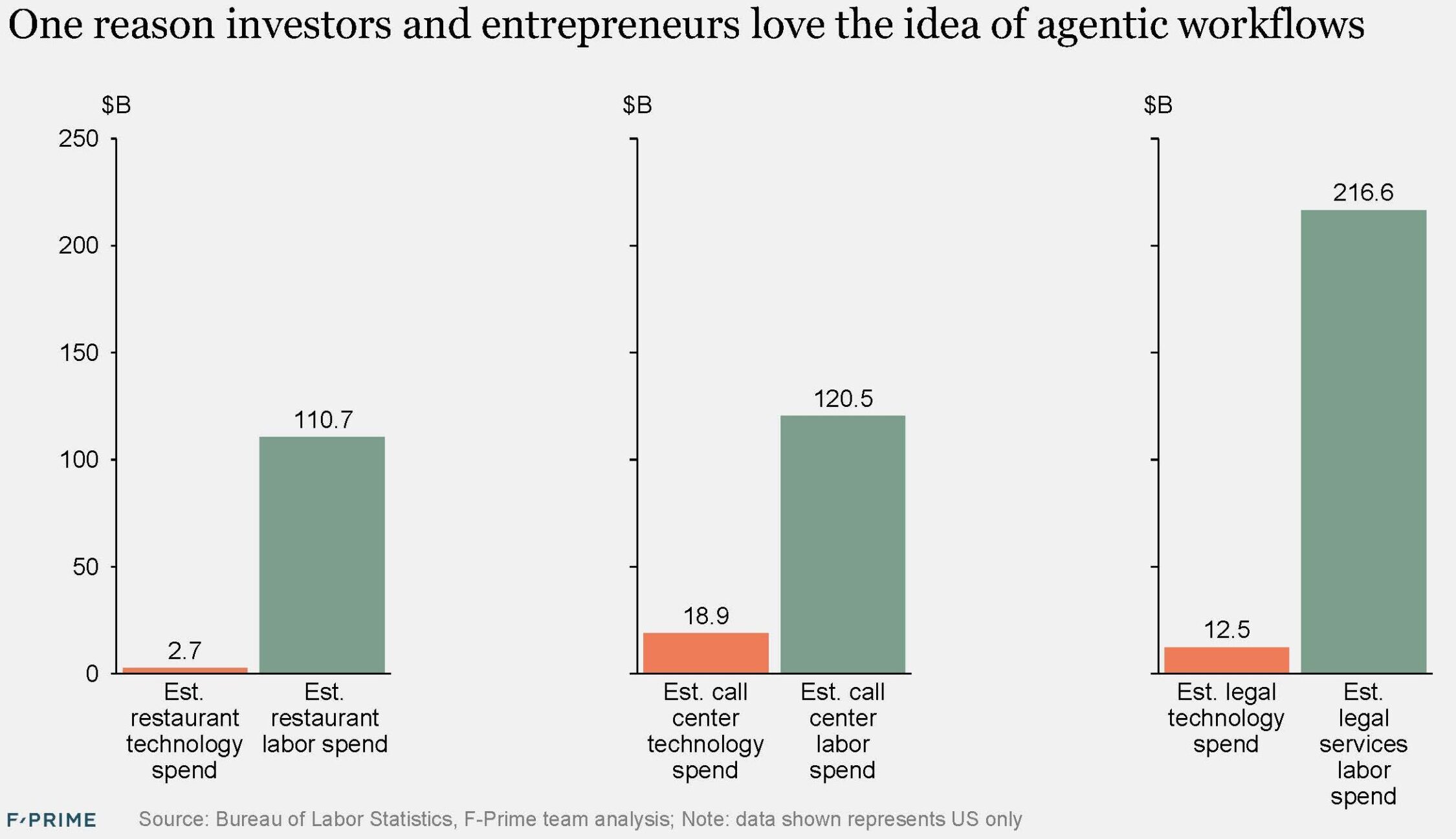
However, over the last three years we have started to see how much labor spend AI can actually capture. TLDR: It’s a lot less than the headlines, but still a large expansion from SaaS. I anticipate software spend will increase 2-3x with the addition of agentic workflows.
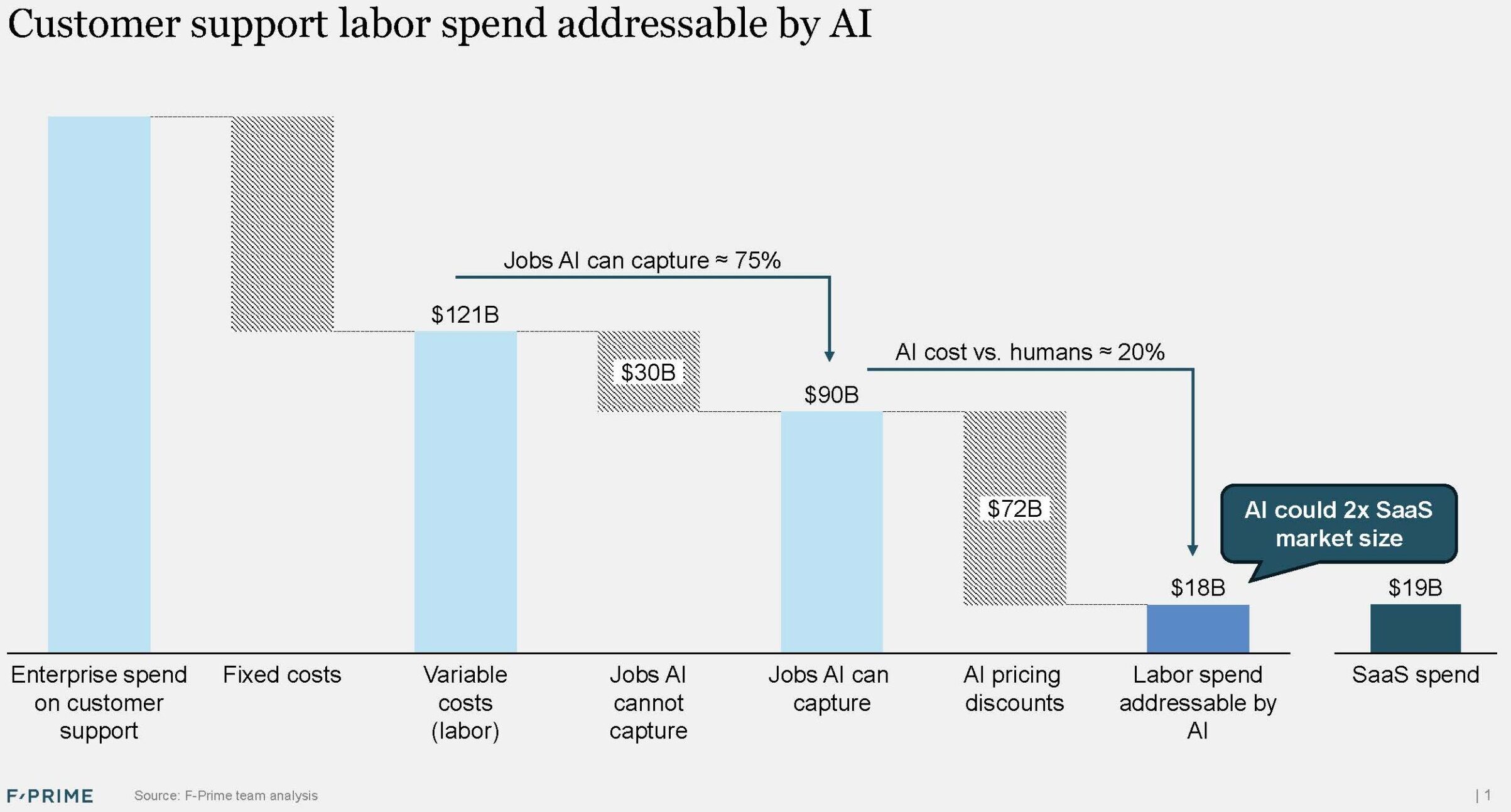
The answer will vary a lot by industry, but I am using this framework for sizing the AI market opportunity. I will illustrate it with customer support data, one of the earliest adopters of AI in the enterprise.
There are three main drivers.
#1 Fixed vs. variable costs. Call centers will continue to have management teams that hire and manage employees, procure technology, analyze data, and make decisions. Of a total customer support budget, it is typical to see 40% fixed costs, leaving 60% variable human costs doing the actual work of customer support.
% of jobs that AI can handle. This number will steadily rise as AI gets better and enterprises customize agentic workflows to their specific needs; however, it’s not going to be 100% of all customer support interactions for many reasons – one-off or highly complex support needs, enterprise unwillingness to integrate AI agents with high-risk systems like payments or prescription ordering, etc. However, out of the gate, we have seen AI handle 50% of chats and emails (less of voice calls), encouraging enterprises to target 75% deflection of support from live humans. It’s impossible to know where this settles, but 75% is possible, if optimistic. Over a long enough horizon, I will bet on AI’s inexorable improvement.
AI cost vs. humans. It is fascinating to see AI vendors pricing AI agents at 10-20% of their comparable unit of labor replacement. For example, it costs many companies $5-10 per customer support interaction (variable only), but AI vendors like Sierra, Decagon, and Maven often charge ~$1. That is 80-90% variable spend reduction for enterprises…and reduced market size for AI vendors. To be sure, as companies grow, their customer support interactions gr ow, and so will the AI market opportunity, but all things equal, aggressive AI pricing deflates the market size.
In summary, there might be 10-30x more labor spend than SaaS today, but it is probable that only 10-20% of that is accessible to AI. That is better news for people worried about losing jobs to AI, but worse news for investors hoping for a larger market opportunity. In the end, there are many ways AI could capture more labor spend, and even take spend from SaaS, so this framework will evolve. We will all learn together.
Truth Systems
Truth Systems is building the monitoring, governance and policy engine that enables enterprises such as law, financial services, and beyond – to guide how AI is used, detect and prevent misuse. Their approach puts control back in the hands of compliance and security teams, turning acceptable-use policies into active enforcement that ensures AI remains aligned with human intent, values, and trust.
Chance Mathisen
Chance is an Associate at F-Prime, where he focuses on early-stage investments in enterprise software. Before joining F-Prime, he was a consultant in Accenture’s Software & Platforms Strategy practice, advising leading hyperscalers and technology companies on go-to-market, product, and market expansion strategies.
Chance holds a B.S. in Managerial Economics from the University of California, Davis.
Robotics on the Rise: The State of Robotics Investment in 2025
Updating our annual report.
We had the opportunity to provide a mid-year update on our State of Robotics report at RoboBusiness 2025. The buzz at the conference was palpable, as this year is proving to be an incredible year for robotics. The market is hitting an inflection point with investment on pace to hit record highs, public and private market valuations growing rapidly, exits accelerating, and innovation continuing to offer transformative opportunity. The future of robotics is more exciting than ever!
We invite you to download the report here, and reach out to authors Sanjay Aggarwal and Betsy Mulé.
Kanastra
Kanastra is a Brazil-based fintech company providing end-to-end infrastructure solutions for the country’s rapidly expanding private credit market. Its platform integrates fund, securitization, and banking services — covering the full operational lifecycle — with deep automation to help originators, asset managers, and banks scale portfolios with greater transparency, efficiency, and control. Kanastra is setting the standard for how private credit infrastructure matures in Brazil and across Latin America.
F-Prime’s Summer Internship and Fellowship Program: Meet Our 2025 Interns and Fellows
A big thank you to our interns and fellows for their valuable contributions this summer!
This summer, F-Prime was excited to welcome a talented group of interns and fellows to our Cambridge and London offices. They played key roles in competitive landscape analysis, sourcing, founder calls, and more. Read on to discover what it’s like to be part of our internship and fellowship programs.

“This experience has deepened that interest, especially seeing how these tools might fit into real business contexts like VC. Listening to discussions where those kinds of possibilities are explored has also been hugely motivating. ”

“The work is creative. I expected rigorous diligence, but I didn’t anticipate how much of the job involves pattern recognition, storytelling, and forming contrarian but grounded views on where a field is heading. You’re constantly toggling between scientific depth and high-level strategic vision.”

“I am most surprised by how fast-paced and rapidly evolving the job is. The team has many new calls every day, while also having to study new technologies, keep up with the news, and manage the portfolio companies. I am learning a great deal about how to manage all these aspects of being a venture capitalist.”

“I have come to further appreciate how the venture framework is about asking the right questions rather than having all the answers. The best investors seem to pair scientific curiosity with disciplined judgment, which has given me a deeper appreciation for how to approach underwriting risk.”

“One thing that stood out is how hands-on and multidimensional the team is at every level. I expected sharp and high-level strategic thinking from partners, but it was refreshing to see just how engaged they are in the details; in every meeting, building models, debating sourcing strategies, refining TAMs.“

“I was most surprised by the rapid pace of innovation and how quickly the team collaborates to evaluate and act on exciting new opportunities. I also learned how important building relationships are in the VC world. it’s not only about finding good investments but also about fostering long-term relationships with founders and industry leaders.”

“I learned about F-Prime through a family friend. I decided to join as an intern because F-Prime gets to work with amazing biotech startups and help them grow as a business. Additionally, the culture at F-Prime is extremely friendly and everyone at the firm wants to help you be the best version of yourself.”
Applications for our 2026 program are not open yet, but if you are interested in learning more, please send an email to careers@fprimecapital.com.
Kanastra: Private Credit Infrastructure Gets A Full-Stack Overhaul
At F-Prime, we have long tracked the rise of alternative assets as they become a core piece of the modern investment portfolio, and the subsequent rise of infrastructure players enabling their expansion. Within “alts”, private credit has been one of the fastest-growing and most overlooked segments. With some estimates for the asset class standing at $1.8T (largely driven by direct lending in the US), others have sized the more complex asset-based finance market in emerging economies closer to $20T. In countries like Brazil, regulators are actively encouraging investment in private credit while simultaneously spurring the creation of new non-bank and fintech loan originators. Thanks to macroeconomic and regulatory tailwinds, the market has grown 230% over the last five years, driven largely by private markets behemoths such as Ares and Patria expanding their footprint into private credit. The sector’s AUM has now outpaced the technology that supports it, with both funds and originators relying on manual, headcount-heavy processes and technologies.
As co-founders of a $500M asset management firm in Brazil, Gustavo Mapeli and Manuel Netto were well-acquainted with the pain of managing a burgeoning asset class with outdated technology. The pair built and then spun out a software product that would solve those pain points, and the result is Kanastra: a back-office platform to manage private credit funds, enabling funds and originators to more efficiently structure, manage, and monitor private credit facilities.
Currently, there is very little infrastructure to support private credit markets in emerging markets, and Kanastra has emerged as an all-in-one tech platform for funds and originators alike. In a market with too many service providers to interact with on a manual basis — fund managers, fund administrators, custodians, controllers, securitization companies, BaaS platforms, loan-as-a-service providers, and monitoring agents — the company provides a tech-forward fund admin solution with end-to-end platform features. The team’s product roadmap is smart and ambitious, with plans to automate onboarding, day-to-day management, risk management, monitoring, analytics, and business intelligence.
We were thoroughly impressed by Gustavo, Manuel, and the Kanastra team when we first met in 2022, and it has been exciting to watch their growth in the years since. Kanastra is well on its way to becoming the leading fund admin provider in Brazil, serving some of the country’s largest banks (Itaú), investment management companies (XP Investments), private credit funds (Patria Investments, Vinci Partners), and originators (Solfácil, Creditas). Earlier this year, Kanastra secured a strategic investment from Itaú alongside a commercial agreement.
At F-Prime, we are proud to have backed foundational companies in the capital markets arena like Kensho, FutureAdvisor, and Canoe Intelligence. Today, we are thrilled to announce that we are leading Kanastra’s $30M Series B. Congratulations to Gustavo, Manuel, and the whole team on the milestone, and we look forward to the years of partnership ahead.
Tenzin Jampa
Tenzin Jampa joined F-Prime in 2025 as a data scientist, where he focuses on data science and automation. Tenzin graduated from MIT in 2025. During his time at MIT, he conducted research at the Laboratory for Nuclear Science, worked on analyzing the early data samples from the 2024 LHCb Run, and evaluated Large Language Models for physics domain specialization. Tenzin enjoys writing and occasionally publishes on his blog. In his free time, he loves to watch or play soccer, go on walks, play video games, or read.
Tenzin holds a B.S. degree from MIT in Physics and Philosophy.
Eric Blatte
Eric joined F-Prime in 2021 as a Venture Partner focused on executive leadership and go-to-market functions in technology and cybersecurity companies. Eric has founded and helped lead organizations from startup to $100 million plus revenue, including RiskRecon (acquired by Mastercard), Trusteer (acquired by IBM), Imprivata (IPO), and Centra Software (IPO).
Eric earned his undergraduate degree from Wharton School of University of Pennsylvania and his MBA from MIT Sloan School of Management.