Blog

Mineral Tree

Mineral Tree provides accounts payable automation software for finance professionals at growing organizations. Mineral Tree was acquired by Global Payments in 2021.


An Eight Roads investment. Eight Roads is F-Prime’s sister venture capital investment group, with which F-Prime collaborates on investments outside of the Americas and Europe.

* Denotes activity with the non-F-Prime investment team.

Securonix

Securonix is working to radically transform all areas of data security with actionable security intelligence. Their purpose-built, advanced security analytics technology mines, enriches, analyzes, scores and visualizes customer data into actionable intelligence on the highest risk threats from within and outside their environment. Using signature-less anomaly detection techniques that track users, account and system behavior, Securonix is able to detect the most advanced insider threats, data security and fraud attacks automatically and accurately.


An Eight Roads investment. Eight Roads is F-Prime’s sister venture capital investment group, with which F-Prime collaborates on investments outside of the Americas and Europe.

* Denotes activity with the non-F-Prime investment team.

Icertis

Icertis, the leading enterprise contract management platform in the cloud, solves the hardest contract management problems on the easiest to use platform. With Icertis, companies accelerate their business by increasing contract velocity, protect against risk by ensuring regulatory and policy compliance, and optimize their commercial relationships by maximizing revenue and reducing costs.


An Eight Roads investment. Eight Roads is F-Prime’s sister venture capital investment group, with which F-Prime collaborates on investments outside of the Americas and Europe.

Whatfix: A New Breed of Global SaaS Start-up

Whatfix

Enterprise SaaS has been a prolific sector for start-up creation over the last decade. Billions of dollars invested, and billions of dollars returned to investors and employees. Notably, almost all in the US. However, enterprise SaaS is becoming a global opportunity, both in terms of target markets and company creation. Through our investments teams across the globe, F-Prime and EightRoads are in the unique position of being at the forefront of investing in these global enterprise SaaS opportunities. We are excited to announce our most recent joint investment in Whatfix, a company we believe can become the next great global SaaS company.

The Whatfix Digital Adoption Platform

Whatfix, a company started in Bangalore, India, is helping define a new class of software user experience for customers across the globe. Historically, software user experience was mostly an afterthought; when the alternative is paper and pencil or spreadsheets, the bar for delivering a high-quality user experience is low. However, as spend on software by enterprises has increased, and the software is increasingly a key driver of operational excellence, there is an acute need to find better ways to drive digital adoption and to ensure employees are deriving full value from the software. Legacy approaches of off-line training, support desks, and help documentation were never very effective, and the ‘consumerization of IT’ means today’s employees expect software to be intuitive to use.

Whatfix helps solve the digital adoption challenge with their contextual, in-app support tools. Across any enterprise application, Whatfix’s product suite enables delivery of support at the exact time the user needs it and at the precise place in the application where it is needed. The support can also be personalized to the user’s past behavior (e.g., first time user) or to their role in the organization. In addition, product usage analytics enable Whatfix to help identify the most commonly used features and the most commonly faced issues to enable further improvement of business processes. Through this suite of capabilities, hundreds of Whatfix customers are already seeing significant uplift of employee engagement across their key enterprise software tools, including Salesforce, Oracle, and Workday.

One of the most interesting aspects of Whatfix’s product is they collect robust usage data across a suite of enterprise applications. Looking ahead, they expect to leverage this unique data asset to provide predictive support, anticipating challenges employees will face, and to automate much of the tedious work of accessing and maintaining data across these applications.

Building a global product business out of India

Whatfix is a true pioneer of the next generation of global enterprise SaaS companies from India. While the technical talent from India has always been world-class, building global product businesses has been a longer journey. However, the last several years has seen the emergence of several significant success stories, such as Freshworks and Druva. Given the best-in-class SaaS growth metrics and unit economics that Whatfix already enjoys, we believe they are well on their way to joining this elite group.

The path Whatfix founders, Khadim and Vara, took to build the company is one we hope many future entrepreneurs from India can learn from. Here are a few of the key decisions they’ve made:

Rapid product iteration and customer feedback: Khadim and Vara have personally spent significant time with their global customers to get feedback on early versions of the product and to ensure product market fit at every step of the product lifecycle

Hiring entrepreneurial leaders: recognizing the lack of experienced hires in India who have built global SaaS businesses, they prioritized hiring leaders with entrepreneurial experience, who bring not only a deep sense of ownership to their roles, but also a willingness to learn and innovate best practices

Building a low-cost inside sales team in India: capitalizing on the increased willingness of enterprises to buy products through an inside sales-led approach, Whatfix has continuously optimized the sales hiring profile, sales pitch, and lead nurturing process to successfully sell high five-figure and even six-figure deals out of India. This has been a critical stepping stone to eventually building a high-impact field sales team in the US

Setting up in the US in the early days of the company: early in the life of the company, once they validated product market fit, Vara relocated to the US and Vispi, an early investor, joined as head of sales, based in the US. Investing early in being close to the customer not only helped build credibility for the company with international customers, but it also tightened the cycle of product feedback

Continuously learning: Khadim and Vara have been true students of building a global start-up, proactively finding mentors amongst many of the leading SaaS entrepreneurs in India and also seeking out guidance from experienced global executives across every functional area

Whatfix is a remarkable company, both in terms of the value they bring to their clients and in their ability to chart their own path to building a global company. We are fortunate to be investors, and we are excited to partner with Khadim and Vara on the next leg of their journey!
Percy

Percy is a visual testing platform that automates the detection of UI changes by capturing screenshots, comparing them against baselines, and highlighting visual differences. Integrated into CI/CD workflows, Percy supports cross-browser and responsive testing, enabling teams to identify visual regressions early in the development process. Its AI-powered visual engine reduces false positives and streamlines the review process, facilitating faster and more confident releases.

Whatfix

Whatfix is a leading digital guidance and engagement platform that helps companies provide intuitive onboarding, and effective training and support. Whatfix’s contextual and personalized in-app content drives-up user productivity and engagement.

Plaid Acquires Quovo — Another Brick in the New Financial Services Tech Stack

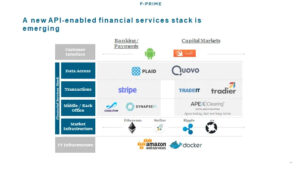
Last year I gave a talk at a FinTech Sandbox event about the new financial services tech stack, showing Quovo and Plaid emerging as the new data access layer. Last week, less than one year later, news broke that Plaid acquired Quovo for over $200M. This new infrastructure layer feels solidified.

F-Prime Capital co-led Quovo’s Series B round and I have had the joy of working with co-founders Lowell Putnam and Niko Karvounis as they willed their way through the challenging early years when no one but financial advisors cared about account aggregation, and later as they surfed the tsunami of new applications incorporating account authentication and aggregation. They did it with grit, humility and class.

In the future, I think we will look back on the Quovo-Plaid merger as a significant milestone in the FinTech wave of disruption. For one, I believe the combined Quovo-Plaid will become the data access layer in the new financial services tech stack. In addition, this merger is happening at the same time as authentication and aggregation move from a ‘nice to have’ to a ‘must have,’ and as we transition from building out the infrastructure to delivering analytics and insights. We are moving from Chapter 1 to Chapter 2, but it won’t stop there.

A quick view on the past, present and future.

Chapter 1: new consumer financial data infrastructure. Together Quovo and Plaid have helped millions of consumers connect their financial accounts to services like Venmo, Coinbase, Betterment and to a long tail of other financial service providers. They connect to over 14,000 financial institutions and provide clean consumer transaction data via APIs, making it easy for consumers to add a bank account for payments (e.g., Venmo), transfer funds into their brokerage account (e.g., Stash), see their categorized spend in budgeting tools (e.g., Personal Capital) and power frictionless rewards programs (e.g., Drop). They are literally everywhere consumers touch a financial service. They do not move money; but they provide the metadata, and in the process have enabled hundreds of new FinTech applications and services.

As a combined entity they will continue to build out the infrastructure in the US and soon the world, but we are already well on our way to Plaid and Quovo owning the data access layer of the new financial services stack.[i]

Chapter 2: analytics and insights. What do you do once you have poured the foundation? You build on top. Plaid and Quovo are now helping businesses analyze consumer data to make better decisions in an automated, real-time way. Lenders like SoFi use Quovo to estimate W-2 income when a consumer applies for a loan, rather than asking for tax returns. Stash uses Quovo to predict the best day to move funds from a consumer’s bank account to help them avoid overdraft fees. Insurance companies can quickly authenticate a policy holder’s bank account to direct deposit insurance proceeds, rather than sending a check. The surface area is wide and Plaid and Quovo should someday generate 3–4x more revenue from derived insights embedded into business workflow.

Chapter 3: what’s next? One inevitable path is for Plaid and Quovo to give consumers more tools to control access to their financial data. In all of my examples, consumers proactively permission use of their data, but what do they do afterwards? Consumers will need easy dashboards to track and revoke access when for instance they no longer use a service. Plaid and Quovo will be well-positioned to do this on behalf of consumers and may become consumer brands themselves in the process. The combined entity can turn over many other cards and it’s exciting to consider other ways they could leverage their data access and analytics, such as, to support identity or credit verification.

Closing thoughts

There are many issues to navigate, from Open Banking in Europe to privacy and regulatory concerns in the US, but I’m optimistic that the triad of regulators, financial institutions and data access providers will act sensibly and with consumers’ interests in mind. If so, the combined Plaid and Quovo has a tremendous future ahead.

And if all goes well, in several years closing documents for company mergers will not require investors to submit their bank account numbers in writing…the final irony in the merger of the two leaders in digital account authentication.

[i] To be fair, time did not start with Quovo and Plaid, and for more than a decade Yodlee (now part of Envestnet) was the data access layer and one of the great early FinTech success stories.

Josh Feinblum

Josh is a cofounder of Stavvy, a Boston-based fintech company, where he leads product, engineering, people, and finance. A lifelong technologist, Josh has focused on entrepreneurship, financial services, cybersecurity, privacy, and anti-fraud technology. Josh has been responsible for building and leading teams — from niche startups to large federal agencies — tackling some of the world’s largest fraud, abuse, and security challenges. Before Stavvy, he served as the Chief Security Officer (CSO) at DigitalOcean where he oversaw the legal operations, trust & safety, security, and fraud & abuse teams. Josh also launched Rapid7’s security organization, operating as the CSO he functioned as one of the corporate spokespeople and a member of the product leadership team. In addition to his operational background, Josh continues to serve as a professional advisor at the Martin Trust Center for MIT Entrepreneurship.

Josh earned his Bachelor’s degree from the University of Maryland and his MBA from the Sloan School of Management at MIT.

A student was tasked with sending his international tuition payment to the university — but the entire process lacked transparency.

While preparing to attend MIT in 2008, an international student was tasked with sending his international tuition payment to the university – but the entire process lacked transparency.

His payment couldn’t be tracked, so he had to hope that it would be delivered before the deadline—if it was delivered at all.  The payment was subject to fees and fluctuating exchange rates, affecting the total amount that would be actually delivered. Wire transfers rarely included essential student information universities required to post funds correctly. Schools frequently received insufficient funds because of the wire fees, and had to send additional bills to students or bar them from registering for classes. Confident a better process could exist, Flywire was created.

Flywire partners with schools and hospitals to receive payments from around the world, easily reconcile them with their accounting systems, and provide consumers with a seamless payment experience.

Mike Massaro was an early employee leading sales for Flywire that became CEO at the same time F-Prime invested in its Series A round. Mike has led the company to tremendous growth in the education sector and lead its successful expansion into the healthcare industry as well. It’s a world leader in vertical payments, having processed over $8 billion for 1,600 institutions.

Flywire aligned well with F-Prime’s investment theme of vertical payments. Flywire is a leading example of solving a simple problem with a great user experience and an elegant, scalable business model. Mike has built a truly global company with a culture of transparency, empowerment and authenticity. Flywire is headquartered in Boston with operations in London, Manchester, Valencia, Shanghai, Singapore, Tokyo, Cluj, Sydney, and Chicago.

Pony.ai

Founded in late 2016 by former Baidu Chief Architect James Peng (CEO) and programming legend Tiancheng Lou (CTO), Pony.ai aims to revolutionize the future of transportation by building the safest and most reliable self-driving technology.


An Eight Roads investment. Eight Roads is F-Prime’s sister venture capital investment group, with which F-Prime collaborates on investments outside of the Americas and Europe.