Healthcare is the next wave of data liberation

At F-Prime, we have been closely involved in the liberation of financial, to the benefit of service providers and consumers alike. In this story for TechCrunch, Carl Byers and David Jegen reflect on how while the winners in healthcare data transformation will look different than they did in the realm of fintech, even as the industry heads toward a similar end state.

Originally published in TechCrunch. Read the full story here.

1upHealth

1upHealth provides data interoperability between healthcare systems at a very low cost, fractions of a cent per API call, utilizing the latest FHIR® standards, and patient-authorized access, to ensure the best insights at the lowest costs across healthcare providers for low-income, diverse, and vulnerable populations.

Betsy Mulé

Betsy Mulé is a Principal at F-Prime, where she focuses on early-stage investments in enterprise technology and robotics. Prior to joining F-Prime, she was a strategy consultant at Mars & Co. where she advised Fortune 500 companies across the US, LatAm and Europe.

Betsy is a graduate of MIT where she majored in Chemical-Biological Engineering.

Mozper

Mozper is bringing the weekly allowance into the digital era in Latin America. About 70% of the population in the region has never received formal financial education, and do not have the right tools to teach their children. In Brazil and Mexico alone, parents give more than $10B each year in pocket money to kids. Mozper offers a Visa debit card and an app where parents can give their kids an allowance, set spending rules (so they can’t blow it all on video games), assign chores and even create and track savings goals.

ConnexPay

ConnexPay is revolutionizing the payment distribution process by offering a combined merchant acquiring and virtual card issuing solution for mid-sized companies. The company’s technology simplifies an antiquated workflow, eliminates the need for pre-funded accounts, reduces supplier risk and the cost of accepting card payments while safeguarding consumer spend. Backed by F-Prime Capital and BIP Capital, ConnexPay is becoming the industry leader in payments for industries historically viewed as high risk to payment providers.

Announcing our Investment in ConnexPay

Managing payments on behalf of their customers is essential to powering the best customer experience possible.

If you’ve ever purchased a trip with Booking.com, a gift from Etsy, or insurance from an agent, you’ve experienced the critical role that brokers, agents, marketplaces, and other intermediaries play in our society. Far from being simply middlemen, these intermediaries own the customer relationship and more importantly customer experience, providing essential value to customers such as a brand they trust, price comparison, product recommendation, or simply coordination across multiple parties to simplify the purchase experience.

These groups are massive contributors to the economy — travel agents, freight brokers, and insurance agents alone control over $1.5T of spend in the U.S. — and yet their customer experience often falls short when it comes to managing payments. Right at the point of purchasing, many intermediaries are forced to turn over the customer to the party providing the product or service (e.g. a travel agent passing your credit card details to the hotel or airline for processing), sacrificing control of the customer payment experience at the most critical time and losing the ability to manage refunds, chargebacks or ongoing purchase updates thereafter.

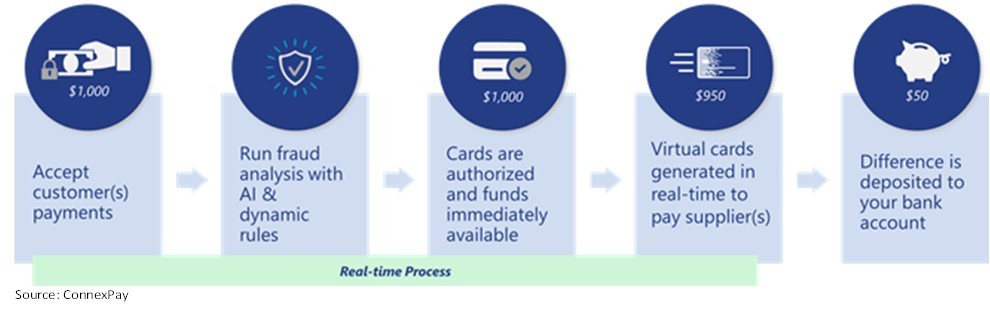
We believe intermediaries are a critical backbone of commerce. Managing payments on behalf of their customers is essential to powering the best customer experience possible. We’re excited to announce our investment in ConnexPay, a company that puts transparency and control of payments back in the hands of these important businesses that own the customer relationship. ConnexPay has built a powerful platform that tackles the infinitely complex problems intermediaries face when it comes to payments — accepting consumer cards, paying suppliers, routing payments intelligently, managing fraud, chargebacks and refunds— and exposes it all with a simple set of APIs.  This elegant and truly end-to-end solution empowers intermediaries to facilitate the payment for their customers by becoming the merchant of record with the flip of a switch, thereby improving profitability, reducing fraud, speeding reconciliation, and removing the need for pre-funded accounts and credit lines.

This problem is particularly apparent in the travel industry, where ConnexPay got started. Online and offline travel agents remain an enormous force in travel, processing ~$740B in total global spend each year. Travel is paid for immediately on booking, yet travel agents and OTAs (Online Travel Agents) typically have a one to two day lag awaiting funds settlement from travelers. Further, agents want control over the customer experience, latitude to negotiate supply in advance from suppliers, and the ability to take commission directly out of the payment flow versus reconciling on the back-end with suppliers. ConnexPay solves all of these problems by helping agents become the merchant of record, supported by its unique solution granting instant funds availability.

Illustrative payment flow for an intermediary with ConnexPay:
It’s an elegant solution, and one which we are especially excited about having long searched for disruptive businesses in travel payments. In the same way our planes aren’t flying any faster than when we were kids, payment tech in travel has hardly evolved to the digital world. From our own portfolio, we’ve seen first hand the incredible value of integrated vertical payments solutions (e.g. Toast, Flywire) and the opportunity for technology disruptors in travel and hospitality (e.g. OTA Insight, Avantstay). Our ongoing search for solutions improving the bewildering, complex world of travel payments led us to ConnexPay.

At the outset of the COVID pandemic, we started talking about investments in terms of scratches and scars. Urban exodus: scratch or scar? Work from home: scratch or scar? Time and again, the travel industry has shown resilience coming out of every existential crisis it has faced, man-made or otherwise. Some might believe global travel will never fully recover; we believe our increasingly globalized world is nowhere near the ceiling on tourism and business travel. With the hopeful news of a COVID-19 vaccine, we like many others are dreaming about life when we can travel once again.


While ConnexPay began in travel, its growth during this challenging period for the industry only strengthened our belief in the value of their solution. We’re equally excited the team is demonstrating success beyond the travel sector and into insurance agencies, freight brokers, and e-commerce marketplaces. We’re especially thrilled to be partnering with ConnexPay Founder and CEO, and payments industry veteran, Bob Kauffman, whose leadership roles at US Bank and Elavon propelled the vision for ConnexPay. Bob has attracted a talented team of payments experts, including JacobBethJulieKunalJudson and many more. Thanks for welcoming F-Prime Capital as part of your story!

Odaseva

Odaseva partners with the largest and most sophisticated organizations in the world to accelerate their trust in business-critical cloud applications. Fortune Global 500 industry leaders use Odaseva technology to back up and restore data, ensure data privacy and regulatory compliance, and use data to drive operational agility. Engineered for Salesforce by Salesforce experts and endorsed by Salesforce Ventures, Odaseva is trusted by 30+ million users and has received 100% five-star reviews over eight years on the Salesforce AppExchange.

Argyle

Argyle provides a single global access point to employment data. From that access point, any business can process verifications, gain real-time transparency into earnings as well as view and update worker profile details. By removing the barriers between a worker, the companies they make money from, and the business they buy services and products from Argyle has reimagined how employment data can be used. Argyle was founded in 2018 and operates out of New York.

Tapping into the future of warehouse robotics — Part 2

Several new or re-imagined robotics categories are seeing significant investor interest and market adoption.

In part 1 of the series, I discussed some of the guiding design principles for the next generation of warehouse robotics start-ups, including scalability, resilience, ease of integration, and ROI. Building on these principles, several new or re-imagined robotics categories are seeing significant investor interest and market adoption. Each category is fundamentally changing how warehouses deliver operational efficiency, invest in technology, and perform workforce planning.

Automated storage and retrieval systems (AS/RS): Supply chains are increasingly being built around local micro-fulfillment centers that ensure faster delivery times and lower-cost operations. This is particularly true in the grocery industry, where delivery times are most critical. These centers often deploy automated storage and retrieval systems that combine high-density goods storage with automated item retrieval using a built-in gantry system. Providers such as Autostore, Attabotics, and Fabric leverage machine learning to deliver higher throughput solutions in a much smaller footprint than traditional AS/RS providers. These solutions are adept at optimizing both the strategy for storing goods and the strategy for retrieving goods to minimize order fulfillment time. For example, Autostore’s Cube Storage Automation System can store up to 15,000 SKUs within 604 square-meters.

Automated guided vehicles (AGVs): Movement of goods between shipping, receiving, and storage locations in warehouse facilities is often enabled by automated guided vehicles. Traditional AGV solutions travel along predefined routes, typically painted lines on the floor. However, newer providers such as Fetch, Vecna, and Otto Motors are leveraging autonomous navigation capability to provide much greater adaptability for changing use cases and routes, resulting in faster deployment time and greater dynamic movement. Fetch has turnkey and extensible systems that safely find, track, and move anything from parts to pallets in warehouses, factories, and distribution centers

Inventory drones: Modern warehouse efficiency requires high-quality data on the movement of goods in and out of the warehouse. Traditional methods of inventory data collection are commonly human-centric and infrequent, leading to errors and limited real-time visibility of what is in a warehouse at any given time. Companies such as Vimaan, GatherFlytbase, and Ware are building autonomous inventory management drones. Gather’s drones can accurately scan and catalog aisles 15x faster than humans, 30x cheaper and with zero downtime.

Parcel-handling Robots: Goods and parcels typically enter and exit a warehouse through a parcel-handling process. Unloading, unpacking and re-loading completed orders into a sortation system or delivery truck are requirements in nearly every distribution facility. Parcel handling is a labor-intensive job with high rates of turnover. Handling larger boxes and packages has a unique set of requirements that companies such as Pickle Robot, Plus One Robotics, and Dexterity are beginning to solve. Advanced technology and motion planning allows these systems to move parcels in production environments, designed to work alongside their human counterparts and operating collaboratively.

Pick-Assist Robots: As the scale of distribution facilities continues to grow, collecting customer orders has become extremely labor-intensive. Workers walk upwards of 10 miles a shift picking items off shelves in the order fulfillment process, expected to collect an order every 33 seconds. Not only is this process highly inefficient, as most of the time is spent walking from location to location, it can also lead to frequent worker injuries. Companies such as Locus Robotics and 6 River Systems are providing robots that replace unproductive walking time with autonomously navigated goods carts. Workers can focus on transferring goods from storage shelves to carts, and the robot does the ‘walking’. Worker productivity is enhanced by 2–3x, reducing dependence on labor and the risk of worker injuries.

Piece-picking Robots: Given the prevalence of the ‘piece-picking’ activity throughout the warehouse, many view this use case as the ‘holy grail’ of warehouse robotics. Order fulfillment requires the handling of individual items at various points of the fulfillment process, ultimately resulting in the packaging of goods in an individualized order. Picking up items and packaging might sound like a trivial task for humans, but it’s deceptively difficult for machines to efficiently calculate how to grab the next “thing.” RightHand Robotics, KindredBerkshire Grey, and Soft Robotics are building robotics solutions leveraging computer vision, machine learning, and special grippers to pick and transfer individual items, often from highly unstructured scenarios — e.g. miscellaneous goods in a storage bin.

Enabling Solutions: Along with various use-case specific offerings, there is also significant innovation around the enabling technologies that will accelerate the deployment of new robotics solutions. Companies like Veo RoboticsScalable RoboticsFreedom Robotics, and Ready Robotics are creating tools to simplify the implementation of customer-specific use cases and are also making it making it easier to deploy solutions that can safely operate in the presence of people.

The pace of automation adoption across the industry is accelerating as offerings reach maturity and buyers feel increased pressure to improve operational efficiency. The global warehouse automation market is already worth over $10 billion today, and it is expected to double in size over the next 5 years as new technologies continue to see adoption. The combination of capabilities and guiding principles will significantly expand the scope of automation available, lower barriers to adoption, and enhance the potential for operational efficiency.

Abdul Abdirahman

Abdul is a Principal at F-Prime, where he focuses on early-stage investments in B2B software and fintech. Prior to joining F-Prime, Abdul invested in emerging markets-based technology startups and worked with a venture-backed digital banking/payments startup in East Africa. He began his career in financial services where he carried out assurance and valuations services for venture capital, private equity and hedge funds in New York & London.

Abdul holds B.A & B.S degrees from the University of Minnesota. He also holds joint MBA & MPA/ID degrees from Stanford’s Graduate School of Business and the Harvard Kennedy School.