Pioneering Progress: The Lenmeldy™ Story

Orchard Therapeutics’ Lenmeldy™ is a first of its kind treatment for an ultra-rare pediatric hereditary disorder.

F-Prime is dedicated to advancing pioneering science and technologies that redefine patient care. Since 2002, F-Prime has facilitated the regulatory approval and commercialization of 33 products and drugs. In our series, Pioneering Progress, we will be showcasing the success stories behind the approval of drugs and products from our portfolio companies.

A Devastating Childhood Disease

Metachromatic leukodystrophy (MLD) is an ultra-rare hereditary disorder caused by mutations in the ARSA gene which render the body unable to break down certain lipids inside cells. This results in progressive destruction of a fatty protective layer on the outside of nerve cells called myelin, leading to impairment of an individual’s movement, severe neurological decline, and ultimately death.

MLD is estimated to affect 1 in 40,000 to 1 in 160,000 live births worldwide1. The disease most commonly manifests in infants and young children, though it can present later in life. Symptoms vary depending on the age of onset but typically include muscle weakness, difficulty walking, loss of motor skills, cognitive decline, seizures, and loss of vision and hearing.

Historically, there has been no way of stopping the disease’s progression and treatment options have been limited to symptom management and supportive care.

New Hope for MLD Patients

Recognizing the potential for bone marrow gene therapy to transform how patients with ultra-rare diseases such as MLD are treated, F-Prime partnered with Bobby Gaspar, M.D., Ph.D., a world-renowned physician and Professor of Pediatrics and Immunology at University College London’s Great Ormond Street Institute of Child Health. Working with Bobby and his global network of academic collaborators, F-Prime formed a new company called Orchard Therapeutics.

Using the combined expertise and resources of F-Prime, Bobby and his collaborators Orchard assembled a portfolio of gene therapies that act on the bone marrow of patients. In 2018, Lenmeldy™ entered the spotlight when Orchard acquired the gene therapy programs of GSK, as the big pharma pivoted away from rare disease.

“As a leading expert in bone marrow gene therapy for severe inherited disease, Bobby brought deep technical and clinical know-how to fuel Orchard’s R&D. F-Prime supplemented his expertise with a company creation engine,” said Alex Pasteur, Ph.D., Partner at F-Prime. “We were a thought partner to Bobby throughout the founding of Orchard, and we helped him to acquire the Lenmeldy program from GSK.”

Throughout its development, Lenmeldy consistently generated promising clinical data, which earned the project lead program status within Orchard’s pipeline. Due to the rarity of MLD, it was essential to educate regulators and other stakeholders about the natural history of the disease, difference clinical methods for assessing symptoms, and Orchard’s new approach.

Upon reaching market approval in Europe in 2020 (as Libmeldy™) and in the U.S. in 2024 (as Lenmeldy™), the therapy became the first-in-class disease-modifying treatment for MLD patients. At the time of approval, the product had the most extensive follow-up data for any gene therapy in the U.S., demonstrating the treatment’s long-term safety and efficacy.

The approval of Lenmeldy was based on studies involving 37 children who received a single dose of the gene therapy2. Remarkably, 100% of children with pre-symptomatic late infantile (PSLI) MLD who were treated with Lenmeldy were alive at six years old, while only 58% of children in the natural history group survived to that age. At five years of age, 71% of children treated with Lenmeldy were able to walk independently, and 85% exhibited normal language and performance IQ scores – outcomes that had not previously been observed in MLD children. Additionally, a slowing of motor and cognitive decline was observed in children with pre-symptomatic early juvenile (PSEJ) and early-symptomatic early juvenile (ESEJ) MLD.

Stakeholder education remains a priority for Orchard post approval of Lenmeldy, with the focus shifting from regulators to physicians and payers. To ensure that the full patient population benefits from Lenmeldy’s curative potential, it has been important for Orchard to accelerate adoption by rolling out standardized diagnosis and newborn screening programs.

Empowering Change with Strategic Investment

We extend our appreciation to Bobby, his collaborators and the entire Orchard team for their efforts throughout the journey of Lenmeldy, which marks a groundbreaking advancement in the treatment of MLD. The success of Lenmeldy not only transforms the outlook for MLD families but also demonstrates the potential for bone-marrow gene therapy to address other severe inherited neurometabolic diseases.

“Our partnership with Bobby – who has spent 10 years at Orchard immersed in company creation, clinical development, regulatory engagement and business development – continues with Bobby joining F-Prime as Venture Partner, ready to help F-Prime build another company with an innovative approach and a mission to help patients in life-altering ways,” said Pasteur.

F-Prime is committed to building transformative companies by supporting the next generation of innovators as they tackle the toughest challenges in healthcare. The success of Lenmeldy serves as an inspirational example, offering hope to MLD families and fueling continued efforts toward future breakthrough treatments for rare diseases.


  1. Chang, SC., Bergamasco, A., Bonnin, M. et al. A systematic review on the birth prevalence of metachromatic leukodystrophy. Orphanet J Rare Dis 19, 80 (2024). https://doi.org/10.1186/s13023-024-03044-w
  2. https://www.fda.gov/news-events/press-announcements/fda-approves-first-gene-therapy-children-metachromatic-leukodystrophy 


From Surge to Sobriety: The State of Robotics Investment in 2024

Updating our annual report

Over the last several years, the investment environment has been tough for robotics startups. Capital deployment has fallen and companies have closed as the general downturn in tech investment that started in 2022 hit the resource-intensive robotics particularly hard. We have tracked that decline — and identified green shoots of recovery — in our annual State of Robotics reports.

This year, however, the picture has changed drastically. Betsy and I were asked to speak about this changing environment at the RoboBusiness conference earlier this month, and as we near the year’s end we thought it would be worth sharing our findings with the wider community.

One of the key drivers of growth in the robotics sector has been the falling costs and higher performance of the technology’s building blocks — things like computing power, sensors, motors, and batteries. At the same time, accelerating advances in AI have been a tailwind for the industry.

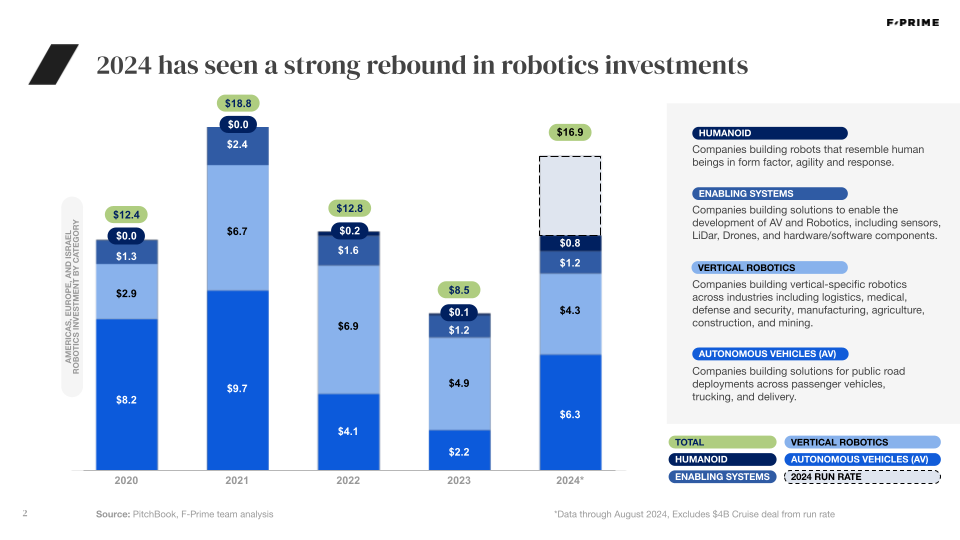
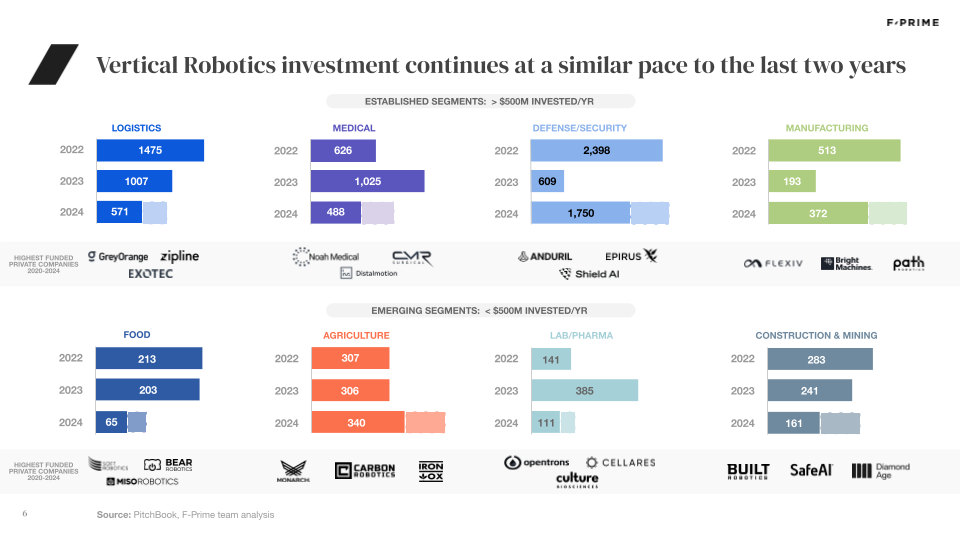
These trends are showing in the investment data. After a sharp pullback in 2022 and 2023, the first eight months alone of 2024 have seen an increase in investment over all of last year, and we expect the full year investment activity to approach the all-time highs seen in 2021. At the same time, companies at different stages and across different industries are seeing sharply different investment dynamics play out.


Where Is the Money Going?

We typically break robotics into three core segments; this year, however, given the increased industry interest and investment in humanoids, we have broken them out into a fourth category of their own. There was already close to $1B of investment in that category through August 2024, with companies like 1X, Apptronik, and Figure commanding huge funding rounds for general-purpose humanoid form factors. Investors include traditional VCs, corporate players, and AI darlings. Meanwhile, some big corporations (like Tesla and Boston Dynamics) are opting to build their own humanoids in-house, investing huge sums that may even dwarf the venture rounds that typically make headlines.

Meanwhile, after falling off considerably in 2022, autonomous vehicle investment once again accounts for the majority of robotics investment, driven by corporate mega rounds and coinciding with a number of legislative and business milestones. For example, Waymo reached 100,000 rides per week while companies like Aurora have been able to expand their operations to new states this year.

We’ve also seen a lot of interest in the software layer this year — particularly foundational models. Companies have attempted to build software for robotics for some time now, but often run into interoperability, scalability, and reliability challenges. Advances in AI are helping companies get closer than ever to overcoming those obstacles, but there are still challenges. Such models need to be inherently multimodal, understand relationships between physical objects and reason/react when the real world presents unexpected challenges. With improvements in multimodal large language models, everyone — startups, corporates, academics — is chasing the one foundational model to rule them all, though data scarcity and other constraints mean we are far from a “ChatGPT moment” for robotics.

After briefly taking over from AVs as the main destination for robotics investment in 2022 and 2023, Vertical Robotics continues to grow steadily. Over the last year, in particular, we’ve seen big interest in applications for the defense and agriculture industries — see Anduril ($1.5B) and Saronic ($175M) for the former, and Monarch ($133M) and Carbon ($56M) for the latter.


By Stage

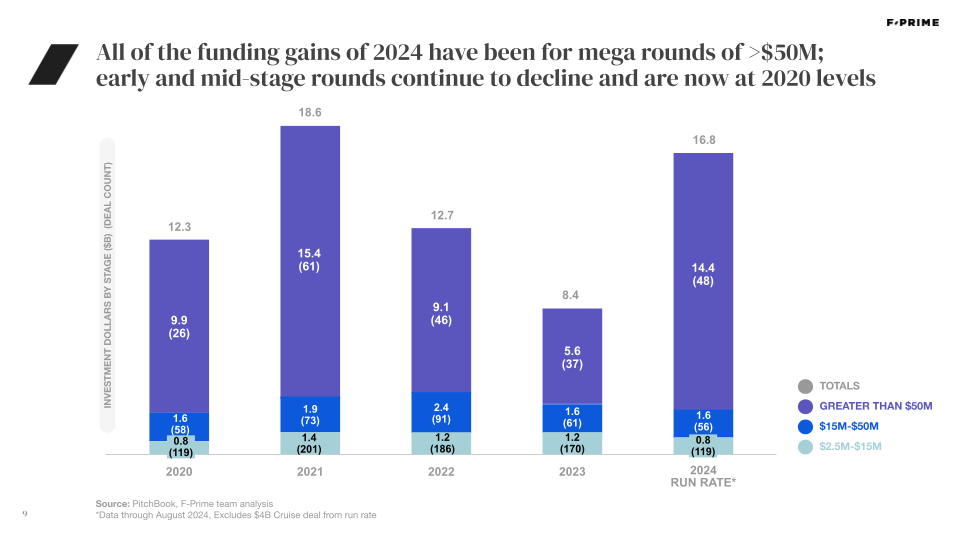
Though funding in the robotics sector has surged, the vast majority of capital has gone to large, mostly late-stage funding rounds. Earlier rounds are actually down year-on-year and back to 2020 levels. Those rounds are also a very small portion of the broader venture ecosystem. In robotics, earlier rounds account for 15 to 20 percent of total capital, while that figure is 20 to 30 percent for the broader venture ecosystem. The majority of the late-stage mega-round funding typically flows to AVs, defense and (this year at least) humanoids, the majority of early stage deals are focused on vertical robotics.


Exit Outlook

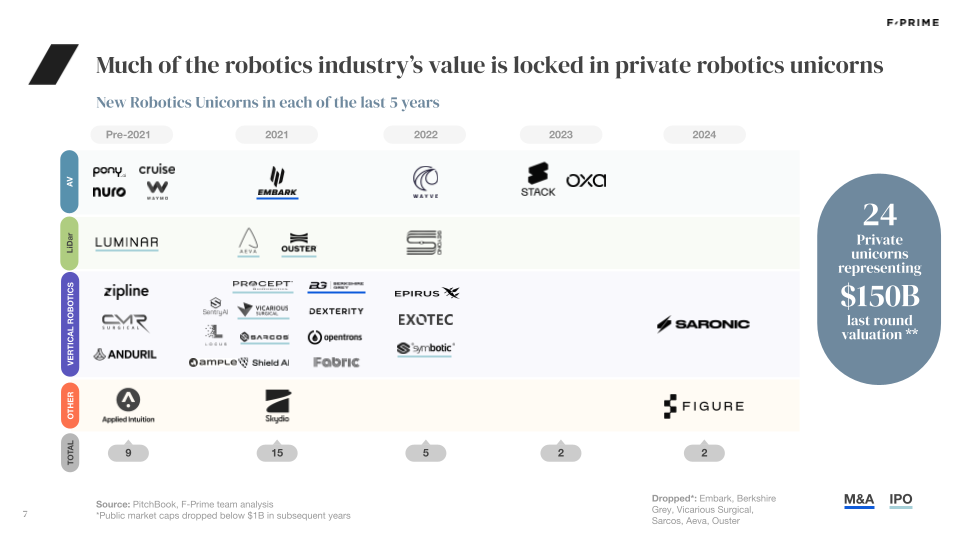
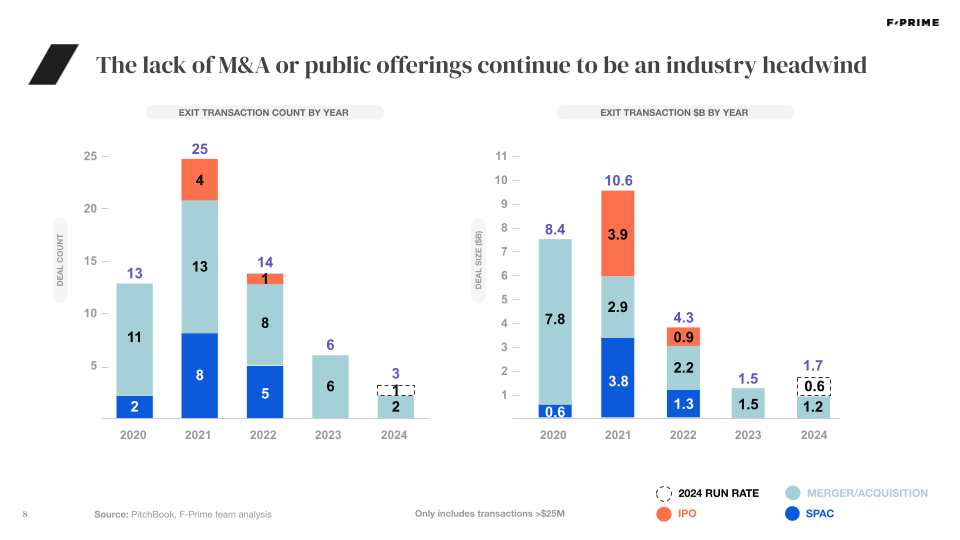
A dearth of successful robotics exits has created a lot of uncertainty around potential returns in the category, and those companies that exited via SPAC or IPO prior to the slump have performed poorly in the public markets. Much of the robotics industry’s value remains locked up in private unicorns, and a lack of M&A or public offerings continue to be an industry headwind. And amid all the mega-rounds, we have also seen many well-funded robotics companies shut down or undergo restructuring over the last 18 months. High profile shutdowns include Zume ($446M raised), PrecisionHawk ($139M), Phantom Auto ($95M), and Ready Robotics ($44M).


Advice to Founders

The long term tailwinds behind robotics are unmistakable. At the same time, attracting early-stage investor dollars to build a robotics business is getting increasingly challenging.  Crossing the gauntlet of delivering high ROI, customer traction, and technical defensibility can be challenging in the early days of any venture-backed business, though it is particularly challenging in robotics where capital needs are higher and product iteration cycles are longer.  Founders must be laser focused on hitting commercial and technical milestones at every step of the journey, while being realistic about the funding environment. Fortunately, for those who manage to cross the gauntlet, there are significant investor dollars looking for opportunities to help build generational businesses in robotics.

Check out the full State of Robotics report here.


“One of the key drivers of growth in the robotics sector has been the falling costs and higher performance of the technology’s building blocks — things like computing power, sensors, motors, and batteries. At the same time, accelerating advances in AI have been a tailwind for the industry.”

— Sanjay Aggarwal

The Effects of RIA Stack Fragmentation

Sneak Preview: A Wealth Tech Deep Dive.

The last decade of wealthtech investment has been marked by the success of high-profile names like Robinhood and Coinbase (two companies we track in the F-Prime Fintech Index), but despite the success of many direct-to-consumer businesses, there are equally exciting opportunities emerging in the world of traditional advisor technology. Several market shifts — an expected $84T wealth transfer, the rise of alternative assets, breakaway RIAs, and advances in AI — all represent an opportunity to rebuild the industry’s technology infrastructure.

Startups are already wise to this opportunity. Witness below the jump in market penetration for estate planning software — from four percent to 39 percent between 2021 and 2024. High-profile funding rounds from players like Vanilla and Wealth.com this year also help demonstrate how hot this sector is as of late.


In the above chart — which comes from our upcoming State of Wealth deep dive, due out next month — you can also see the growing sprawl of the advisor’s tech stack. RIAs must now contend with a wide array of tools with little-to-no integration across platforms, and startups have emerged to create tighter integrations.

There are three main approaches to this problem:

  1. Some players are creating pre-integrated tech stacks via acquisition. For example, Orion Advisor Solutions started life as a portfolio management tool that acquired financial advisor CRM Redtail and investment and trading platform TownSquare Capital in 2022. The goal here is to acquire different pieces of the RIA tech stack from top-to-bottom and the challenge, of course, is to integrate those pieces.
  2. Others are opting to create new age all-in-one platforms from the ground up. In effect, the end-to-end platforms built by companies like Advyzon and Advisor360 end up looking similar to the pre-integrated tech stacks discussed above, but instead of building via acquisition they are founded with the intention to become an all-encompassing platform.
  3. The third solution is tech stack synchronization. Under this paradigm, advisors are free to use their favorite point solutions for each level of the RIA tech stack, and use an orchestration platform to ensure that data is flowing seamlessly between them. Companies like Dispatch enable advisors to collect, structure, and sync client data across various advisor platforms, ensuring that any data changes made in the CRM are reflected in financial planning and portfolio management tools, and vice versa.

As David wrote when announcing our investment in Dispatch earlier this year, “This is one of those deep infrastructure solutions that solves an enormous pain point, offers an immediate ROI, and can run in the background as the integration layer for customer data. The more integrations they support, the more valuable they become to the industry.”


Originally published on Fintech Prime Time.

New Digital Care Architecture: The “Four Ds of Digital Health” Meet the “Two As of Automation”

Building on the “Four Ds of Digital Health”, two key automation advancements are being incorporated to make an impact: artificial intelligence and API-based services.

A new digital care architecture is transforming healthcare by integrating the Three Ds of healthcare delivery (doctors, drugs, and diagnostics) with data, AI, and API-based services, creating a more accessible, personalized, and efficient system for both patients and providers.


The modern healthcare delivery system requires a new architecture, powered by technology and tech-enabled services. 

Key Trends Demand Systemic Change

Myriad trends are rendering our traditional care delivery system ill-suited to today’s challenges:

– Provider supply constraints cannot meet rising demand 

– A system built around acute care is not well suited to managing chronic conditions 

– Digital interfaces give rise to new modes of engaging in patient care

– Financing is shifting from fee-for-service to value-based models

– Expensive breakthrough therapies proliferate in pharma, biotech, and medical devices

– Administrative burdens have grown exponentially requiring better infrastructure 

The design requirement for a new digital care architecture is clear: care must be more accessible, always-on via multiple channels that mix digital and physical delivery, tailored to the specific care plan of each patient. This requirement cannot be met in a world where traditional delivery systems focus more on consolidation for negotiating leverage than on making care affordable and/or easy to access.

Data as a Key Component of Care Delivery

Data deserves a full seat at the table alongside the traditional Three Ds of healthcare delivery: doctors, drugs, and diagnostics. Indeed, there now are Four Ds of Digital Health. Without accurate, robust, and real time data, it is not possible to get the care you deserve. When care can be personalized, the quality of the data is as important to patient health as everything else. 

So, the era of asking “where does it hurt?” and starting from there no longer works because without rich information about your medical history, diagnostic testing, and the full complement of medical records that have accompanied your lifetime of care, practitioners cannot give you the best that medicine has to offer in a way that is convenient, reliable, and efficient. In many cases, your genetic profile, your family history, or insights from prior episodes of care are vital to ensuring that you get the right procedure, the right drug, and/or the right care recommendation. 

This goes beyond the testing and data requirements of a given specialist. Yes, GI docs need to know inflammatory marker levels before creating a care plan, and cardiologists need real-time data on cardiac function and fluid status to fine-tune heart failure therapy. But, these providers also need to know what is going on for a patient across the care continuum, including plans and histories of the patient related to conditions other than the specific one they are treating. Similarly, primary care physicians need to know what is happening for a patient in all of these areas, particularly when there are multiple chronic conditions at play. Powered by AI tools noted below, physicians now access patient data via concise, cogent summaries of care episodes without wading through the “PDF graveyard” inside their EHRs (if they have that information available to them at all).

The “Department Store” Model Doesn’t Work

Health systems have responded to data challenges by suggesting simply that all the information should be housed in one medical record in a healthcare environment completely controlled by that one entity. Think of this as the “department store model.” Macy’s had one of everything, so you didn’t need to go anywhere else. Yet, consumers wanted more. They wanted a wider variety of brands, lower price points, and diverse channels. Hence, Amazon came along and former department stores are now being converted into housing for the elderly.

It’s a similar dynamic with health delivery. Large health systems seem to say, “Just never leave my four walls, and everything will be ok.” They hoard data if not required by the government to share it and their technology partners embrace this model. And this works for them. With everything under one roof, they can charge more for everything. Yet, research shows that as health systems get larger, the cost of any one service goes UP not down, while quality deteriorates. Adding insult to injury, patients cannot access these systems readily, due to a combination of supply constraints and process inefficiency. The bill for this inefficient model is borne by society broadly, via higher prices paid by employers, patients, and whoever prints T-Bills in the U.S. Treasury. Remarkably, even when everyone is using the same medical record, outcomes are not better with respect to cost or quality. Even with all the data in one place, the “department store” is still under-gunned compared to the power of the marketplace to deliver cost and quality to the end user (the patient). 

A Better Solution: Unbundling Care Delivery, Powered by The Four Ds and Two As

Care delivery needs to evolve so that each patient is seen by the right provider at the right time, in a way that is convenient for patients.

Today, care is bundled in the form of large health systems, in part because the data is disparate and unbundled [1]. Once the data is put in one place and is comprehensive, accessible to anyone at any time, care delivery can be unbundled in a way that enhances value. When companies like Zus Health make data ubiquitous (mediated by privacy and consent) we can step away from data hoarding, mediated by health systems and their legacy technology vendors.

This allows an actual market to develop, so that healthcare can finally benefit from the economies of scale and the power of technology in ways that bear fruit in most other industries. The power of markets to generate new value propositions, breathtaking levels of cost reduction, and delightful consumer experiences is well known. Just look at anything you do with Amazon or e-commerce, buoyed by fintech and advanced logistics, we live in a world where almost anything feels possible in the retail environment.

Health care certainly is different than that. Most patients do not have the knowledge to make accurate shopping decisions in the healthcare context, but that’s changing given the proliferation of AI tools which depend crucially on access to data. Additionally, when data is unified, care can be unbundled, which means that you can seek advice from any care provider, liberating you from the slog of what primary care has become in large health systems today, allowing you to access new modes of care that are better tuned to the realities of life today.

What kills patients is not so much acute episodes or infections, important as those care moments can be, as chronic diseases, best addressed by persistent, more available solutions.

This looks like comprehensive primary care that is more convenient for you because it sits in the palm of your hand, available all the time, provided by companies like Firefly, Oak Street, or Aledade. These “medical homes” take risk for total costs, so they invest in a longitudinal relationship; as “health fiduciaries,” they are accountable both for health and cost. These entities manage their patients proactively, developing rich user experiences for accessing care virtually or in-person and navigating the system on behalf of their patients, including partnerships with  specialized care providers. If a patient has an eating disorder, the medical home can ask Equip to address it; GI issues can be handled by Oshi; while patients on a fertility journey access Carrot. This type of dynamic and integrated care provision is made possible when all participants can read from, and write to, the same dataset and coordinate seamlessly. Unlike an all-in-one department store like the Mayo Clinic, this model provides an open network, where a marketplace can emerge with richer, more tailored and higher value services, mediated by an organization accountable for your health and your budget. Fluid data enables this.

The four Ds of digital health will unlock new opportunities for quality and cost improvement and many of the startups featured at the HLTH conference illustrate this. The Four Ds themselves, however, are not enough. That is why I am adding to the framework The Two As of Automation. 

The Two As of Automation: “The Big A” and “The Other A”

Automation is about making sure that work is performed reliably, consistently, and in a cost effective way. With automation, care providers and the companies they work with can get things done at the touch of a button, or – better yet – without pushing a button at all. 

So, what are the Two As of automation? These can be broken down into “The Big A,” the one everyone can’t stop talking about, which is artificial intelligence. But true transformation of the care delivery system also requires “The Other A,” API-based services. Pranay Kapadia, CEO of Notable, previewed this post and explained that “agents” perhaps could be their own “A” in this framework; they straddle the line between APIs and AI and represent a key innovation vector.

When data is unified and care can be unbundled, then every care provider can operate independently. Doing this efficiently requires automation, which scales best with a marketplace of B2B services to get all sorts of work done.

There are enormous staffing shortages in health care that drive outrageous costs for human beings to do tasks essential to our care. However, increasingly, many of these tasks actually can be done at scale by others just as an Uber ride to the HLTH convention involves APIs for payment (Stripe/Braintree), navigation (Google Maps), and communication (Twilio).

Similarly, every healthcare provider will be able to access via APIs for high-quality and scaled services in areas like scheduling, pre-authorization, patient payments, clinical decision support, remote care management, Rx delivery, and referrals to a plethora of other care providers, who themselves are able to take part in a seamless care journey because everyone can access and contribute to the same datasets. Devoted CEO Ed Park, commenting on a draft of this post, noted that what makes The Two As important is that they can accomplish specific tasks right when they are needed, such as a doctor confirming that a pre-procedure checklist has been completed or a patient finding out precisely where to go for a lab result [2].

Embrace The Failure of Imagination

As Chris Dixon has shown, new innovations usually run into the obstacle of humans’ inability to really comprehend all that technology can do once it has been invented. When the telephone was invented, people at first said, essentially, “Wow, that’s cool, but no one will use it because the telegraph already handles everything.” When the TV was first built, no one could think of anything to do with it initially other than film plays with one camera. No one thought about multiple cameras or going outdoors, let alone adding special effects. It was a failure of imagination, which tends to accompany any new breakthrough technology.

Healthcare now faces the same failure of imagination. Why shouldn’t the care plan sit not just on your smartphone but also on your watch to remind you when it’s time to take medication, to tell you when your activity levels do not align with your exercise goals, and to reach out proactively with a loving AI-driven voice to ask you how you’re doing and give you the opportunity to share your experience, gain reassurance, and make sure you are moving in the right direction with your behaviors, which are as vital to your health as anything? I don’t know what will come of a world where data and care can be unbundled and fully synchronized, but I’m quite sure it will involve profoundly beneficial innovations.

Modern healthcare organizations will innovate based on access to complete data. They will depend vitally on rapidly emerging foundation models and AI tools to support care delivery. Furthermore, a proliferation of services can be integrated into their platforms by technologists using a simple line of code that references these multifaceted services.

The Four Ds and The Two As will bring us a health care future that is unrecognizable today. Crucially powered by privacy and consent, each patient will be able to choose a medical home that is always-on and available, which can help navigate a marketplace of specialized providers/services/apps based on individual care plans.

All-in-One Care To Integrate Digital and Terrestrial Delivery

The goal is a seamless, all-in-one care experience that is delivered via a broad marketplace of providers who can offer tailored care to our individual needs; just ask Lionel Richie

Many people have comorbidities, which require thoughtful guidance and planning from knowledgeable care providers, which is the heart of primary care. But these care providers do not need to operate inside the bowels of large medical buildings that are hard to find without access to complete information about your care, including the care that has been provided to you outside of their own four walls. 

There will be a plethora of data sources that will complement these decisions, including “omics” and diagnostic data and even data from wearables and patient reported outcomes. Today, this data often frustrates care providers because they lack the training to utilize it effectively and do not have the time to incorporate it into your care planning. Hence, they will depend on AI to do the long slog of reviewing data tirelessly, understanding implications for the care plan, looking for deviations of key measures from safe thresholds, and then making the work easy for the care provider to integrate into the care plan and provide the patient with the right advice and new recommendations to keep us all on the right track .

If the goal is to Live to 100, or Die Trying, this will be achieved only with a modern digital care architecture that is convenient and low cost. This system must harness the full power of AI to continuously monitor your health while you enjoy life, only interrupting you when necessary to keep you on the right track.  Health equity demands that healthcare is made radically more accessible, effective, and affordable. A world where data has a prominent role, treated as essential to your care as a doctor, lab, or pharmacist, is a crucial first step. However, only with automation powered by AI and API-related services can anyone keep up with the demands of healthcare and deliver the quality of care you deserve.

So, let’s build a new health system where anything a provider or a patient needs is accessible via automation, powered by the data that is crucial to each person’s health. With the right infrastructure at our disposal, all it will take is some imagination.

Charting the Rise of Stablecoins

The original vision for crypto was ambitious: lower fees, faster transactions, inflation protection, and other features were supposed to create the ultimate low-cost payment network. Thanks to the inherent volatility of the currencies that emerged, cryptocurrencies struggled for many years to gain traction beyond their status as an alternative asset class.

In the last decade, however, we have seen stablecoins emerge, and recent developments suggest they may be the application that fulfills crypto’s original promise of a cheap, efficient, permanently accessible global payment network. Over the last six years, we’ve seen them rise to rival other payment networks.

A stablecoin is a cryptocurrency pegged to the value of a more stable fiat currency—the US dollar is the most obvious and common choice—to facilitate payments that would be expensive and time-consuming by other methods. Fiat-backed stablecoin payment volume reportedly reached $4T in 2023, with some estimates running as high as $9.9T—enough to rival payment volume on traditional players like PayPal ($1.5T), Mastercard ($9T) and Visa ($12.3T). This shows that stablecoins are enabling transactions that would otherwise be slow and expensive, perhaps unlocking a killer use case for crypto.


The broader financial ecosystem is catching on to the value proposition of stablecoins, too. PayPal launched their own stablecoin, called PYUSD last year, and Stripe recently announced it would once again let customers accept crypto payments,namely via USDC stablecoins.


The cross-border use case

Most international B2B payments are facilitated by the SWIFT (Society for Worldwide Interbank Financial Telecommunication) network, a messaging system that sends fund delivery instructions between two banks, which then moves funds using Nostro and Vostro accounts. These payments can be incredibly slow—sometimes taking up to five days—and expensive, as incoming and outgoing transfer fees, FX fees, and tracing fees add up, not to mention the added expenses when intermediary banks are involved. SWIFT payments are also opaque, as senders and receivers lack real-time visibility into the status of a payment.

The current state of play has all the hallmarks of an industry ready for disruption. And in situations where one or more of the parties to an international transaction is working in a volatile currency, stablecoins have further advantages. High inflation rates, local currency volatility and lower access to financial services are driving high adoption of stablecoins in emerging markets, where stablecoins can provide a “stable” store of value. For example, most of Tether’s user base is located in emerging markets. Users in Brazil, Argentina, Turkey and Vietnam are adopting USDT as a “digital dollar,” rather than for trading purposes.


One way we might measure the relative efficiency of different cross-border payment methods is to track the cost of sending a $200 remittance. According to the World Bank, the average cost of sending $200 hovers around 12% or $24. For a similar transaction conducted via stablecoin, the cost varies depending on off-ramp fees, exchange fees and network transaction fees. According to Uniswap, the cost of that same $200 transfer ranges between $9.10 at the high end, and as little as $0.37 on the low end.


The future

While stablecoins have shown promise as a payment method, success depends on the willingness of consumers and businesses to transact in a relatively new and unknown type of currency. To facilitate user adoption, the existing complexity of the crypto ecosystem might need to be abstracted away from users. Meanwhile, as stablecoins function as the “translation” mechanism between foreign currencies, the underlying stablecoin swaps—say, between USDC and the Mexican peso—require sufficient liquidity.

Aside from adoption hurdles, companies building in this space will still need to navigate and mitigate a broad array of regulatory, foreign exchange and concentration risks, both from partner banks and stablecoins themselves. Those that can overcome these challenges will be well-placed to transform how international payments take place, with massive implications for the rest of the world.


Originally published on The Financial Revolutionist.

F-Prime’s Summer Internship and Fellowship Program: Meet Our 2024 Interns and Fellows

A big thank you to our interns and fellows for their valuable contributions this summer!

This summer, F-Prime was excited to welcome a talented group of interns and fellows to our Cambridge office. They played key roles in competitive landscape analysis, sourcing, founder calls, and more. Read on to discover what it’s like to be part of our internship and fellowship programs.


“I loved the constant drive F-Prime had for solving healthcare’s toughest problems. I also appreciated the mission-driven aspect of the investment process, focusing on clinical outcomes as well as the ROI a company could provide. As someone who has now worked on the VC and hospital side of the table, I am excited to see VC firms like F-Prime pushing the innovation envelope in healthcare and working with hospitals, government, payors, and others to make the healthcare system better for everyone.”


“This internship solidified my aspiration to work within venture capital, because of the dynamic nature of the industry, the intellectual challenge of assessing companies and management teams and the innovative approaches founders are taking to solve complex challenges. I’m looking forward to applying my Masters education to invest in and support entrepreneurs in the tech sector.”


“I primarily worked on a landscaping project where I compiled bispecific assets in development for inflammation and immunology, and identified several promising lead assets for potential investment opportunities. Additionally, I contributed to the scientific due diligence of ongoing deals, led several interviews with key opinion leaders (KOL), and participated in introductory calls with prospective biotech companies. I truly enjoyed the process of identifying the “gold” among the vast assets in development through scientific due diligence and KOL interviews. It was incredibly rewarding to see how my efforts in scientific due diligence contributed to an investment decision.”


“I wanted to explore a career option in the biotech industry for after I finish my PhD. I did a landscaping of Th2 immunity in the central nervous system, attended many intro calls, helped diligence companies of interest, and presented to the team on certain companies or spaces of interest.”


I learned about F-Prime summer fellowship opportunities through LinkedIn and joined F-Prime as a summer fellow due to my interest in exploring alternative career paths after graduation, as well as my enthusiasm for gene editing and drug delivery. F-Prime has a remarkable portfolio of companies focused on addressing clinical unmet needs with these technologies. I also joined to gain insight into VC’s perspective on the future of next-generation therapies.”


“I mainly worked on the commercial assessment for a new portfolio company. As part of this, I built an epidemiology model of the disease area, assessed potential market dynamics and exit opportunities, and created a revenue forecast. I most enjoyed working with the new portfolio company team – each person had unique expertise that they were happy to share, and I learned so much from them throughout the course of the project.”


“I learned about F-Prime through a family friend. I decided to join as an intern because F-Prime gets to work with amazing biotech startups and help them grow as a business. Additionally, the culture at F-Prime is extremely friendly and everyone at the firm wants to help you be the best version of yourself.”


Applications for our 2025 program are not open yet, but if you are interested in learning more, please send an email to careers@fprimecapital.com.

Travel Tech’s Startup Moment, Pt. 1: Modernizing the Hotel Stack

For a long time, early stage investors were wary of travel technology. Why?

Because it’s an industry dominated by deep-pocketed Goliaths firmly entrenched within an intricate web of multi-decade commercial relationships. Companies like Sabre, Amadeus, and Opera/Oracle have comprised the industry’s vital infrastructure since the 1970s and 80s, while the likes of Expedia and Booking.comhave dominated the B2C space since the early 2000s — despite not having raised venture capital themselves. That was because the travel industry was slow to adopt new technology, and there were few examples of startups that reached a level of scale and success that would excite investors.

However, the success of VC-fueled companies like Airbnb and Hopper have recently awakened early stage investors to the scale and opportunity in B2C travel tech. Though annual investments in the space have fallen from their 2022 peak, the overall trend is up. And with the emergence of successful growth stage companies like Navan, Mews, and Lighthouse, we believe it’s time to shine a light on the enormous opportunity that currently exists in B2B travel tech.

A perfect storm of market challenges is forcing the industry to rethink its relationship with technology. First, online travel agencies (OTAs) increasingly dominate customer mindshare and diminish suppliers’ margins. Gaping holes have emerged in technology infrastructure and the scalability of existing systems, and are notoriously impacting customer experience. And finally, operational costs have exploded for service delivery, where employee turnover has risen dramatically and highlighted the low desirability of jobs in the industry. As a result, industry players have evolved from a “throwing bodies at the problem” mindset to searching for scalable technology-driven solutions.

For the first time, travel and hospitality providers are adopting new software tools at a rapid pace. According to Hotel Tech Report’s annual survey of hoteliers, 81 percent believe technology will be more important for the success of a hotel business in the next five years. Technology budgets in hospitality have been steadily rising to 4.2 percent of revenue in 2024, with 37 percent allocated to new implementations and R&D. Meanwhile, 78 percent of airline CIOscited an increase in technology investment this year. Over the next several weeks, I’d like to outline three key areas where B2B startups are transforming travel right now, starting with the new operational and commercial tech stack that startups are building for hotels.

Hotels Are Rapidly Adopting Technology Right Now

For hotels, the pandemic exposed many commercial and operational challenges that had been percolating below the surface for some time. Lagging technology left hotels unable to deliver the digital-first experience guests needed, and awoke the industry to its woeful state of software adoption. Consumers were digital-first, but hotels continued to throw people at their problems. Many travelers were (and often still are) shocked at lengthy check-in lines and frustratingly analog guest experiences that other industries had digitized long ago, from tipping to contactless check-in. In an industry with more than 70 percent employee turnover, delivering a great guest experience became a costly challenge for hoteliers. Meanwhile, hotels have been losing their most profitable, direct customer channels as they have been squeezed by OTAs.

In response, hotels have been on a software buying spree to modernize systems. We see three priority areas of investment:

Property Management Systems: The vast majority of hotels run on aging property management systems (PMS), built decades ago by vendors such as Opera (Oracle) and Agilysys. The mission critical nature of a PMS has led these often on-premise solutions to become the proverbial “server in the back of a closet” no one wants to touch. While the PMS has generally proven far stickier than many ambitious entrepreneurs imagined, we are now seeing more hotels hitting the “reset” button and adopting one of the numerous modern, cloud-based options. Frontrunners include Mews, Stayntouch, and Cloudbedswhich, when implemented successfully, facilitate delightful experiences for hoteliers and their guests, and help hotels take a large step forward into a future-proofed, digital-first technology choice.

Guest Experience: Many hotels are hesitant for a wholesale replacement of their PMS, but need a modern platform from which to deliver digital-first guest experiences. Companies like Canary Technologies and Duve are creating a new technology layer serving as the digital interface with guests for interactions such as contactless check-in, digital tipping, messaging and more, without replacing existing infrastructure or increasing headcount. This new category additionally serves as an important jump-off platform for AI in hospitality and is often cited as a top priority new investment area for hotels.

Commercial Operations: Hotels have long had a lopsided bond with OTAs, who increasingly own the customer relationship and drive profitability away from the hotels. This has sharpened hotels’ lenses on commercial operations and ensuring distribution, pricing and profitability are best optimized. With stronger data-science tooling available, startups are bringing high quality data, business intelligence, and recommendations to hotels to help them run their business better. These include full end-to-end commercial platforms (Lighthouse), modern revenue management solutions (Duetto), powerful distribution tools (Siteminder) and far-reaching customer acquisition networks (Sojern).

Up Next: A New Layer for Content Distribution

Pioneering Progress: The FARAPULSE™ Story

Atrial Fibrillation (AF) Challenges and Treatments

Currently, atrial fibrillation (AF) is the most common form of irregular heart rhythm (also known as an arrhythmia) – impacting 40 million people globally1. It is projected that by 2030, the United States alone will grow to have 12.1 million people suffering from AF1. In addition to being a lifelong challenge, AF is a progressive disease that can be fatal, as it is linked to a risk of blood clots, stroke, heart failure, and other serious complications2.

If not addressed, initial symptoms may become more frequent and then permanent, yet only a small fraction of the population (about 15% of cases in the U.S.3) are treated for the root cause of the disease. Most patients are on anti-coagulants or other drugs to prevent clots and strokes; however, those medications have potentially dangerous side effects including bleeding, gastrointestinal issues, hematomas, and more.

“Therapy for AF – a condition that is now recognized as a worldwide epidemic – did not even exist 25 years ago, and we are still in the early stages of treating or even preventing AF,” said Robert Weisskoff, PhD, Senior Partner at F-Prime. “There was a clear need to improve upon existing methods and train an entire workforce of medical professionals to conduct a new procedure that offers patients rapid, safe, and durable results before the disease manifests permanently.”

When F-Prime met the Farapulse team, there were two existing interventions to treat AF – burning or freezing, both with considerable drawbacks. The first option, radiofrequency (RF)-based ablation burns small regions to reverse AF. It was the first technology introduced commercially, but it is lengthy process and requires highly skilled medical professionals. The second option, cryotherapy ablation (cryo), freezes those same regions. Cryo can be completed more quickly but lacks the same precision and control. Both techniques pose risks such as permanent damage to nearby tissues, such as the diaphragm or esophagus, and narrowing of the pulmonary veins. While these risks are relatively small, their potential consequences can be devastating.

Harnessing Technology for Targeted Solutions

In search of a better method to address AF, Steven Mickelsen, MD at the University of Iowa leveraged a technology known as pulsed field ablation (PFA), initially meant to treat cancer. PFA utilizes a high-voltage, low-energy source in a minimally invasive manner to selectively ablate targeted cardiac tissue without heating or freezing. PFA can selectively kill specific cells within a very well-defined region and offers a reliable, one-time intervention that reduces the number of repeat procedures that could be required. The team at Farapulse, led by Allan Zingeler, Raju Viswanathan, PhD, and an experienced MedTech R&D group, adapted the technology into a catheter-based approach that leveraged many of the same advantages of RF and cryo. However, PFA offers a quicker and equally effective treatment, while avoiding the potentially negative repercussions. Additionally, it is simpler to learn than other treatment options, facilitating wider adoption.

The effectiveness of PFA was validated in clinical trials (including a large randomized pivotal trial for the FDA in the U.S.), demonstrating it to be as safe and reliable as conventional thermal ablation methods. Real-world data from the MANIFEST-17K registry, presented at the American Heart Association’s (AHA) Scientific Sessions, further underscored its safety profile across more than 17,000 patients. Building on this success, FARAPULSE™, has since revolutionized atrial fibrillation treatment as the world’s clinical leader in PFA, with over 70,000 patients treated to date. Boston Scientific continues to be enthusiastic about expanding FARAPULSE into new markets, including China and Japan, targeting the latter half of 2024.

Transforming Healthcare with FARAPULSE

F-Prime was among the earliest institutional investors alongside Boston Scientific, to recognize the promise of this transformative approach to treat AF. Boston Scientific identified a significant market opportunity and provided funding for Mickelsen’s original concept, aimed at competing with devices used by cardiac surgeons to treat AF during valve replacement procedures. Throughout the development stages, F-Prime played an integral role, particularly during the transition from an extracardiac to an intravascular approach, ensuring the product’s progression.

Weisskoff attributes the success of the product to a “small but highly experienced team. Our contributions involved helping them navigate fundraising, IP, and personnel dynamics, as well as develop an exit strategy before the U.S.-based pivotal trial.” He also emphasizes that the strategic timing of involving Boston Scientific, which later acquired the company, and the careful structuring of their engagement, were crucial in successfully navigating FARAPULSE through to approval.

Looking beyond AF, PFA technology holds promise for treating other conditions such as type 2 diabetes, where it aims to enhance glycemic control and restore insulin sensitivity. It may also have implications for chronic obstructive pulmonary disease (COPD) – potentially improving respiratory function by widening bronchial tubes. Advancements in PFA-based technologies also have the potential to lead to more selective cancer treatments. Through ongoing support, F-Prime is committed to backing innovative companies like Farapulse that are reshaping the landscape of medicine and are working toward setting a new standard-of-care for diverse medical needs.


  1. Hearth Rhythm Society
  2. Johns Hopkins Medicine
  3. Boston Scientific Crosses the FDA Finish Line with Farapulse, Medical Device and Diagnostic Industry

The State of Banking Report

Over the last few years, we have tracked the public fintech markets’ post-pandemic peak, trough, and recovery, as well as deeper dives on the payments and wealth management sectors.

Today we are excited to release a new report on the State of Banking, available for download below and via the F-Prime Fintech Index. All roads eventually lead to a bank — a bank account, a loan, a payment — and no discussion of fintech is complete without a look at this sector.

For much of the recent fintech disruption, we talked about the unbundling of traditional bank services and the threats to their core revenue streams. Ten years in, incumbent banks haven’t gone anywhere — yet there are scaled players in nearly every banking product line. We have seen the rise of embedded banking, neobanks, open banking, and major shifts in share from bank credit to private credit.

As the chart below shows, the valuation multiples of disruptors have aligned more closely to incumbent banks since the correction, but underlying performance depends a lot on where you sit. The approximately 3,000 banks in the US with less than $500M in deposits are actually shrinking, squeezed by the megabanks at the high end and the neobanks on the low end. More on that below.

So what is driving these shifts in the banking landscape? We’re focused on eight key themes that are impacting banks and their customers right now, each posing varying levels of threat and opportunity for incumbent players.

In this article, we will highlight three of those trends: banking-as-a-service (BaaS), private credit, and stablecoins. To read about neobanks, real-time payments, open banking, non-banks, and AI in banking, check out the full report here.

1. Despite Regulatory Scrutiny, BaaS Is a Source of Growth for Smaller Banks

Banking-as-a-Service is as much a product of necessity as innovation. For hundreds of fintech startups and software companies, BaaS innovation has been critical to lowering the friction and cost of offering financial services to their customers. On balance, we think this has provided immense benefits to consumers and small businesses.

However, as noted above, nearly 3,000 US banks — the majority of banks — are losing deposits. Megabanks like J.P. Morgan, Wells Fargo, Bank of America, and Citibank have grown deposits nearly 10 percent annually, while neobanks like Chime and SoFi have each rapidly scaled to more than $10B in deposits each in under 10 years. BaaS has been a rare source of growth and operating efficiency for some smaller banks.

Smaller banks that have turned to BaaS models have typically restored growth, improved operating performance, and built product differentiation. Banks with less than $10B in assets that provide BaaS services outperform their non-BaaS peers on key metrics. For example, in 2023, BaaS-providing banks grew deposits 18 percent year-on-year (vs. zero percent for non-BaaS peers) and achieved a 1.5 percent return on assets (vs. one percent for peers).

As all readers know, despite the benefits of BaaS, regulators are very concerned about the risks and understandably so. Abstracting KYC, onboarding, and other compliance tasks away from banks via BaaS middlemen was already drawing regulatory scrutiny before the messy collapse of Synapse in the spring. It is clear regulators would prefer banks work directly with startups, not through BaaS intermediaries, and no matter what they must retain ultimate accountability. Going forward, banks with well-developed BaaS programs will have to navigate an increasingly risk-averse regulatory environment.


2. The Rise of Private Credit

The market for non-bank sources of capital has been rising, driven by decades-long market shifts, including bank consolidation (and the corresponding decline in the number of banks) and post-2008 regulation requiring banks to increase reserves and reduce balance sheet risk. Private credit players have stepped in to fill the void, becoming an increasingly important source of capital for consumers and small and medium-sized companies. However, they need purpose-built tools to digitize, automate, and scale their underwriting and portfolio monitoring — creating an opportunity for startups to build new software infrastructure to support the asset class. Rising players include include deal syndication and funds flow platforms like PactFi, diligence and deal closing platforms like Finley, and underwriting, portfolio monitoring and compliance platforms like HighFi and Cascade.


3. Stablecoins — Finally, A Killer App for Crypto?

Under its original vision, crypto would provide the ultimate low-cost payment network. However, thanks to the inherent volatility of Bitcoin and other cryptocurrencies, they struggled for many years to gain traction beyond their status as an alternative asset class.

The promise of stablecoins — cryptocurrencies fixed to the value of a more stable fiat currency — is that they can deliver on crypto’s original promise of a cheap, efficient, permanently accessible global payment network. And over the last six years, we’ve seen them rise to rival other payment networks like Mastercard and VISA. Notably, many of these stablecoin transactions are technical settlement transactions vs “real-money” transactions like e-commerce and cross-border trade, but the direction of travel is clear and the volumes are impressive.

Large banks are also launching their own stablecoins — J.P. Morgan was the first to launch a bank-backed cryptocurrency in 2019, and says it now handles $1B in daily transactions. Use cases include payments between clients in wholesale payments businesses, and treasury and liquidity management. Meanwhile, PayPal launched its own dollar-pegged stablecoin last year, providing a potential payment option for e-commerce and point-of-sale transactions, as well as peer-to-peer cross-border payments facilitated by Xoom.

It remains to be seen whether we will have a world of a few dominant, liquid fiat-backed stablecoins or numerous company-backed stablecoins but either way, the world of commerce could look very different in 10 years. We’re excited to see the infrastructure built to enable it.

Originally published on Fintech Prime TimeDownload the full State of Banking report here.


In a Crowded Savings Market, Deep Industry Experience Set Vestwell Apart

Selling to financial advisors was the best way to distribute savings programs both in and out of the workplace — but only Vestwell knew it

As Co-Founder and Chief Customer Officer at wealth advisory startup FolioDynamix, Aaron Schumm wanted to do right by his employees and help set them up with retirement savings accounts. But he was underwhelmed by his options: fees were too high, service was terrible, and the technology powering it all did not work well.

Later, after FolioDynamix was acquired by Envestnet, Aaron delved into the world of workplace savings, and started the journey focused on 401(k) plans for small and emerging businesses. At the time, 72 percent of workers at companies with less than 100 employees did not have access to a company-sponsored retirement plan. Meanwhile, the industry’s low margins and historically sticky products meant that recordkeepers were consistently underinvesting in technology. The average small-market 401(k) plan customer was losing more than two percent of their retirement savings in plan admin fees, fund and annuity fees, and advisory fees. Spotting an opportunity, Schumm founded Vestwell in 2016 to build a cloud-based recordkeeping platform that would form the underlying infrastructure for workplace savings programs — starting with the 401(k).


“Vestwell was founded to provide advisors and employers with an affordable, compliant, and easy-to-use workplace savings platform to help close the savings gap in America, and F-Prime has supported that mission since our inception.”

Aaron Schumm, Vestwell Founder


The so-called “American savings crisis” goes further than retirement — for example, around 61 percent of Americans cannot afford to pay for a $1,000 emergency. The 401(k) landscape was indicative of the broader savings industry, operating on technology that has largely gone unchanged for 40 years. Retirement savings was just the beginning.

Other players had spotted the same opportunity to focus on the 401(k) market. Vestwell was one of several startups that emerged between 2015 and 2017 to build a new support platform for businesses’ 401(k) plans, and some had already delivered products to market and raised sizable warchests from big-name investors.

However, Aaron’s team possessed a unique insight: the majority of workplace savings programs, including retirement programs, were sold via financial advisors, and not directly to businesses. Vestwell built its platform incorporating the financial advisor as a core stakeholder, giving it the ability to offer far more flexibility in terms of funds, operational and reporting capabilities, and other retirement planning services.


Industry Experience Goes A Long Way

Aside from his experience at FolioDynamix, Aaron had also led or worked on product teams at Citi and Fiserv before starting Vestwell. By the time F-Prime met Aaron, we had been involved in the fintech industry long enough to recognize his strength as an industry veteran who genuinely understood the market better than his competitors.

In the mid-2010s, financial advisors served more than 70 percent of small market 401(k) plans. By building relationships with home offices and trust with individual advisors, Vestwell could efficiently sell to a large number of 401(k) plans — and this was the only viable path to revolutionize the SMB 401(k) market. When Aaron set out to raise his first round of funding, we teamed up with like-minded investors at Primary Venture Partners, FinTech Collective, and Commerce Ventures to help him execute that vision. The following year, we doubled down to lead Vestwell’s Series A.

“Vestwell was founded to provide advisors and employers with an affordable, compliant, and easy-to-use workplace savings platform to help close the savings gap in America, and F-Prime has supported that mission since our inception,” Aaron said at the time.

History has proved Vestwell’s thesis correct. Aaron has successfully led the company to become an award-winning record keeping platform that is far more efficient than any traditional platform today. Vestwell has also gone beyond just 401(k)s, creating the only single platform architecture to power other tax-preferred savings vehicles in and out of the workplace, such as emergency savings, 529 Education Savings, student loan matching payments, and ABLE disability savings programs.

Anticipating the value of public-private partnerships in driving innovation within the savings industry, Aaron has also established key partnerships with state governments. They have overwhelmingly turned to Vestwell for its ability to deliver a personalized savings experience on a state-of-the-art platform that spans all savings vehicle verticals. Vestwell now powers more than 80 percent of the live state auto-IRA savings program in the country.

As the company has rapidly expanded into a leading savings and investment platform, it has over $30B in assets saved and well over a million users employed across 350,000 businesses. In December 2023, Lightspeed Venture Partners led Vestwell’s latest funding round: a $125 million Series D — one of the largest rounds of its type for the year.